What Is a Perfect Vacuum and How Is It Defined?
A perfect vacuum is an environment totally free of matter and pressure, meaning no particles, atoms, or gases exist inside. It represents the ultimate emptiness, with zero pressure and no thermal energy transfer.
This concept is fundamental in understanding vacuums, perfect vacuums, and their role in physics.
In reality, achieving a perfect vacuum is impossible due to quantum fluctuations and material leaks. However, understanding this concept helps in fields like quantum physics and space technology.
Keep exploring to uncover how vacuums are created and their practical challenges.
Key Takeaways
- A perfect vacuum is an environment completely free of matter, including particles, atoms, and dust.
- It represents absolute zero pressure with no gases exerting force inside the space.
- The perfect vacuum has no thermal energy transfer through conduction or convection.
- It exists as a theoretical baseline in physics, characterized by quantum zero-point energy and fluctuations.
- Perfect vacuums are essential for precise scientific fields like quantum computing, particle physics, and space simulation.
What Is a Perfect Vacuum in Physics?
How do physicists define a perfect vacuum? You’ll find it’s described as a space entirely free of matter—no particles, no atoms, nothing at all. In this ideal state, you won’t detect gas molecules, dust, or any form of material substance.
It’s not just emptiness; it’s the complete absence of physical matter. You might think it’s easy to imagine, but achieving a perfect vacuum is practically impossible. Even deep space contains some particles and radiation.
Physicists use this concept to understand fundamental physics, relying on the perfect vacuum as a theoretical baseline. When you study it, you realize it represents an absolute zero point for pressure and matter, helping you explore how particles and forces behave without interference.
How Does a Vacuum Differ From Low-Pressure Environments?
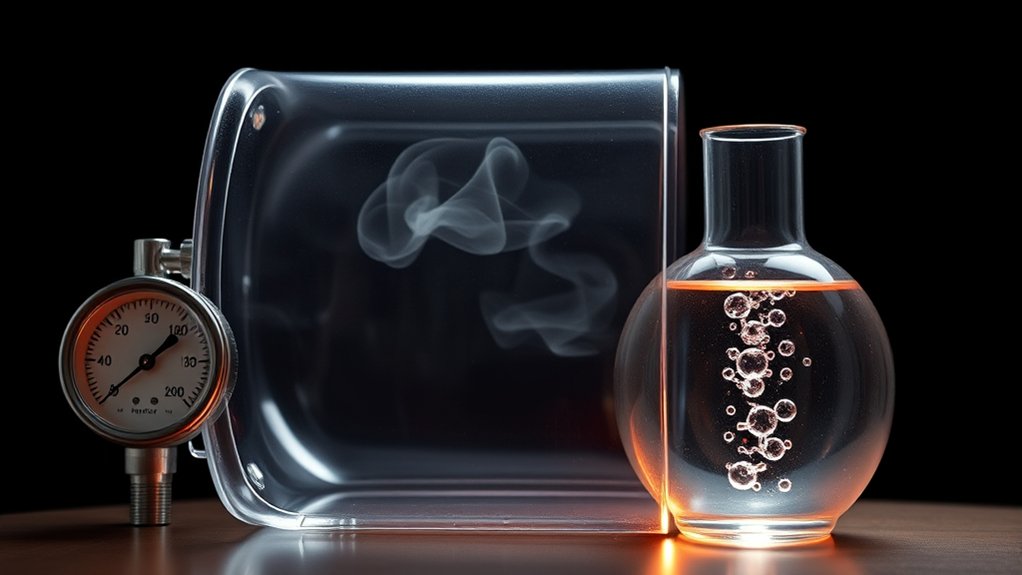
While a perfect vacuum represents an ideal state with no matter at all, real-world conditions often involve low-pressure environments that still contain some particles. You see, a vacuum is an absolute absence of matter, whereas low-pressure spaces simply have fewer particles than normal but aren’t completely empty. This difference profoundly affects how you perceive and work with these environments.
| Vacuum | Low-Pressure Environment |
|---|---|
| No particles at all | Some particles present |
| Absolute emptiness | Reduced density of matter |
| Pure ideal, rarely achieved | Practical, achievable |
Understanding this helps you appreciate the challenges in creating perfect vacuums and why low-pressure systems are more common in experiments and applications.
Why Is a Perfect Vacuum Impossible to Achieve?
You can’t create a perfect vacuum because quantum fluctuations constantly introduce particles, even in empty space. Plus, the materials and tools you use to measure or contain a vacuum always add some particles or energy.
These fundamental limits keep a perfect vacuum just out of reach.
Quantum Fluctuations Limit
Why can’t we ever achieve a perfect vacuum? It’s because of quantum fluctuations, the unpredictable changes in energy that happen even in empty space. These fluctuations mean that particles constantly pop in and out of existence, preventing a true void.
Here’s why this limits a perfect vacuum:
- Energy Uncertainty: Quantum mechanics says energy can’t be zero everywhere, so particles and antiparticles spontaneously emerge and vanish.
- Vacuum Instability: These fleeting particles create a dynamic environment, so space isn’t truly empty.
- Fundamental Limits: The Heisenberg uncertainty principle ensures you can’t precisely define zero particles or energy in any region.
Material and Measurement Constraints
Even if quantum fluctuations weren’t a factor, creating a perfect vacuum remains impossible due to material and measurement constraints. You face physical limits in the materials used to build vacuum chambers—they outgas molecules, releasing particles that prevent absolute emptiness.
Plus, your instruments can’t measure zero particles; they have detection thresholds and noise that mask true vacuum conditions. Here’s a quick comparison:
| Constraint | Cause | Effect |
|---|---|---|
| Material Outgassing | Molecules trapped in walls | Continuous particle release |
| Measurement Noise | Detector sensitivity limits | Inability to confirm zero gas |
| Mechanical Limits | Imperfect seals and joints | Small leaks introduce particles |
These factors guarantee that no matter how hard you try, a perfect vacuum stays just out of reach.
Key Characteristics of a Perfect Vacuum
Although achieving a perfect vacuum is practically impossible, understanding its key characteristics helps clarify what sets it apart from everyday environments. When you imagine a perfect vacuum, think of these defining features:
- Absolute Absence of Matter – You won’t find any particles, atoms, or molecules in a perfect vacuum. It’s entirely devoid of matter.
- Zero Pressure – In a perfect vacuum, there’s no gas or air pressure pushing against surfaces, unlike what you experience at sea level.
- No Thermal Energy Transfer – Since no particles exist to carry heat, a perfect vacuum prevents conduction and convection of thermal energy.
How Quantum Mechanics Explains the Perfect Vacuum
When you delve into the world of quantum mechanics, you’ll find that the perfect vacuum isn’t as empty as it seems. Even in a space free of particles, quantum fluctuations cause temporary particle-antiparticle pairs to pop in and out of existence. These virtual particles mean that a vacuum has a fundamental energy, called the zero-point energy.
This energy prevents the vacuum from being truly “nothing.” Instead, the perfect vacuum is a dynamic state with the lowest possible energy, where no real particles exist, but quantum fields still fluctuate. Understanding this helps you grasp why a perfect vacuum can’t be completely empty and highlights the role of quantum mechanics in redefining emptiness beyond classical ideas.
How Scientists Measure Perfect Vacuum Quality
To understand how close we get to a perfect vacuum, you need to know the techniques scientists use to measure vacuum quality. This includes understanding pressure units and how instruments are calibrated for accuracy.
Let’s explore the tools and methods that make these precise measurements possible.
Vacuum Measurement Techniques
Since achieving a perfect vacuum is nearly impossible, scientists rely on precise measurement techniques to assess how close they get. You’ll find that vacuum measurement involves specialized tools tailored for different pressure ranges.
Here are three common techniques:
- Pirani Gauge – This device measures vacuum quality by detecting changes in thermal conductivity of gas molecules. It works well for medium vacuums.
- Ionization Gauge – For ultra-high vacuum, this gauge ionizes residual gas atoms and measures the resulting current, giving you extremely sensitive readings.
- Capacitance Manometer – This instrument uses changes in capacitance caused by pressure variations, providing accurate absolute pressure values across a wide range.
Pressure Units Explained
Although achieving a perfect vacuum remains out of reach, you can measure how close you get by understanding various pressure units. Scientists use units like pascals (Pa), torr, and millibar (mbar) to quantify vacuum quality. One pascal equals one newton per square meter, while one torr approximates 1/760 of atmospheric pressure.
Millibar is commonly used in meteorology but also applies to vacuum measurements. Ultra-high vacuum systems reach pressures as low as 10^-9 torr, showing how sensitive these units are. Knowing these units helps you interpret vacuum levels accurately and compare results across experiments.
Instrument Calibration Methods
How do scientists guarantee their instruments accurately measure vacuum quality near perfection? They rely on precise calibration methods to assure reliability.
You’ll want to focus on these three key steps:
- Reference Standards – Use well-established vacuum standards, like known pressure points, to set a baseline for your instrument.
- Cross-Calibration – Compare readings from different vacuum gauges under identical conditions to spot discrepancies and adjust accordingly.
- Environmental Controls – Maintain stable temperature and electromagnetic conditions during calibration, as these factors can skew sensitive measurements.
Tools and Instruments Used to Create High-Quality Vacuums
Creating a high-quality vacuum requires specialized tools designed to remove air and gases effectively from a sealed space. You’ll use various instruments, each serving a unique purpose to achieve the desired vacuum level.
Here’s a quick overview:
| Tool | Purpose | Typical Use Case |
|---|---|---|
| Vacuum Chamber | Encloses the space to be evacuated | Scientific experiments |
| Vacuum Gauge | Measures pressure inside the chamber | Monitoring vacuum levels |
| Sealing Gaskets | Maintains airtight seals | Prevents leaks |
| Vacuum Valves | Controls gas flow | Regulates vacuum creation |
| Vacuum Pumps | Initial air removal (discussed later) | Starting evacuation |
Using these tools properly guarantees you create and maintain a high-quality vacuum efficiently and reliably.
How Vacuum Pumps Remove Matter
You’ll find several types of vacuum pumps, each using different methods to remove matter from a space. Understanding how these pumps work helps you grasp their efficiency and the limits they face.
Let’s explore the mechanisms behind their operation and what affects their performance.
Types Of Vacuum Pumps
Although vacuum pumps come in various types, they all work by removing gas molecules from a sealed space to create a vacuum. You’ll find different pumps suited for different vacuum levels and applications.
Here are three common types:
- Rotary Vane Pumps – These use rotating vanes to trap and push gas out, ideal for low to medium vacuum levels.
- Diaphragm Pumps – They use a flexible diaphragm to move gases, great for oil-free applications and smaller vacuum needs.
- Diffusion Pumps – These use high-speed jets of vapor to capture gas molecules, perfect for achieving very high vacuum levels.
Each type operates differently but aims to reduce pressure inside a chamber, helping you create the vacuum you need.
Mechanisms Of Matter Removal
Vacuum pumps remove matter by physically capturing and expelling gas molecules from a sealed space. When you operate a pump, it creates a pressure difference that encourages gas molecules to move toward the lower-pressure area inside the pump chamber. Different pumps achieve this in distinct ways.
For example, rotary vane pumps trap gas between rotating vanes and the pump casing, pushing molecules out. Diffusion pumps use high-speed jets of vapor to direct gas molecules toward the exhaust. Molecular drag pumps rely on rapidly spinning rotors to drag gas molecules along.
Regardless of the method, each pump continuously extracts gas molecules, lowering the pressure inside the sealed space. This process gradually reduces the number of particles, making the vacuum stronger as you remove more matter.
Efficiency Factors And Limits
Since pumps rely on physical mechanisms to remove gas molecules, their efficiency depends on factors like pump design, operating conditions, and the properties of the gases involved. You need to take into account these efficiency factors and limits when working with vacuum pumps:
- Pump Design: Different pumps—rotary vane, turbomolecular, or diffusion—excel at specific pressure ranges. You’ll find some better for rough vacuums, others for ultra-high vacuums.
- Operating Conditions: Temperature, pressure, and contamination affect performance. You must maintain ideal conditions to prevent efficiency loss.
- Gas Properties: Lighter gases like hydrogen are harder to remove than heavier ones. Your pump’s ability to handle various gases influences overall vacuum quality.
Understanding these factors helps you maximize vacuum systems and approach closer to a perfect vacuum—though absolute perfection remains out of reach due to physical and technological limits.
How Temperature Affects Vacuum Creation and Stability
How exactly does temperature influence the creation and stability of a vacuum? When you lower the temperature, gas molecules slow down, reducing their kinetic energy. This slowdown helps you create a better vacuum since fewer molecules escape or outgas from surfaces.
However, if the temperature is too high, molecules move faster, making it harder to maintain low pressure.
| Temperature (°C) | Gas Molecule Speed | Vacuum Stability |
|---|---|---|
| -100 | Very Slow | High stability |
| 25 | Moderate | Moderate stability |
| 200 | Very Fast | Low stability |
Why Perfect Vacuums Matter in Scientific Research
Although achieving a perfect vacuum can be incredibly challenging, it plays a crucial role in advancing scientific research. When you work in near-perfect vacuum conditions, you reduce interference from air molecules, allowing you to:
- Observe fundamental physical phenomena without distortion, helping you understand the universe at its most basic level.
- Conduct experiments involving particles and radiation, where even minimal gas presence can alter results or damage equipment.
- Guarantee precise measurements in fields like quantum mechanics and materials science, where tiny contaminants would skew data.
Engineering and Technology Uses for Perfect Vacuums
When you design advanced electronics or space equipment, creating a perfect vacuum becomes essential to guarantee ideal performance. You rely on these vacuums to eliminate air particles that could interfere with sensitive components, such as in semiconductor manufacturing or vacuum tubes. Perfect vacuums also play a vital role in particle accelerators, where minimizing collisions with gas molecules ensures accurate experiments.
In space technology, vacuums replicate the outer space environment, allowing you to test satellites and instruments under realistic conditions. Additionally, you use perfect vacuums in electron microscopy to improve image clarity by preventing electron scattering. By controlling pressure precisely, you enhance efficiency and reliability across many technologies, making perfect vacuums indispensable tools in engineering and technological innovation.
Challenges Creating Near-Perfect Vacuums
Creating near-perfect vacuums involves more than just removing air; you face numerous technical hurdles that make achieving absolute emptiness incredibly difficult. Even tiny amounts of gas molecules can linger, preventing a true perfect vacuum.
Achieving a perfect vacuum is challenging; tiny gas molecules always remain, preventing complete emptiness.
Here are three major challenges you’ll encounter:
- Outgassing: Materials inside the vacuum chamber release trapped gases over time, contaminating the space.
- Leaks: Microscopic cracks or imperfect seals allow air to seep back in, breaking the vacuum.
- Measurement Limits: Detecting ultra-low pressures requires extremely sensitive instruments, and even they have limits in accuracy.
Each of these factors forces you to continuously improve your methods. Overcoming them demands meticulous design, specialized materials, and constant monitoring to get as close as possible to that elusive perfect vacuum.
Future Directions for Better Vacuum Conditions
As technology advances, you’ll see new methods and materials pushing the boundaries of vacuum quality. You’ll find innovations like advanced cryogenic pumps and atomic-scale surface coatings helping to reduce particle contamination more effectively. Researchers are exploring graphene and other nanomaterials for their ability to minimize gas adsorption, improving vacuum stability.
You’ll also notice improvements in vacuum chamber design, incorporating ultra-smooth surfaces and better sealing techniques to limit leaks. Additionally, AI-driven monitoring systems will enable real-time adjustments, maintaining ideal vacuum conditions longer than before. These advancements mean you’ll get closer to achieving conditions near a perfect vacuum, which is essential for fields like quantum computing and space simulation.
Your role in adopting these technologies will be key to pushing vacuum science forward.
Frequently Asked Questions
Can a Perfect Vacuum Exist Naturally in Outer Space?
No, you won’t find a perfect vacuum naturally in outer space because even the emptiest regions contain some particles and radiation.
Space is incredibly close to a vacuum, but never completely void of matter or energy.
How Does a Perfect Vacuum Affect Sound Transmission?
You won’t hear a single whisper in a perfect vacuum because sound waves need a medium to travel. Without air or particles, sound has nowhere to go, leaving you in absolute, deafening silence.
What Materials Are Best Suited for Vacuum Chamber Construction?
You’ll want stainless steel or aluminum for vacuum chambers because they’re strong, corrosion-resistant, and maintain integrity under pressure.
Glass and ceramic also work well for specific applications, offering excellent sealing and low outgassing properties.
Are Perfect Vacuums Used in Everyday Household Appliances?
You won’t find perfect vacuums in your kitchen—like chasing a mythical ghost, they’re impossible to capture.
Instead, household appliances use partial vacuums, enough to keep your food fresh or clean efficiently without needing perfection.
How Do Vacuums Impact Human Health and Safety?
You should know vacuums improve air quality by removing dust and allergens, helping your respiratory health.
But using them safely matters; avoid exposure to loud noise and make sure filters are clean to prevent breathing in harmful particles.
Conclusion
Imagine chasing a horizon that forever slips away—this is what pursuing a perfect vacuum feels like. You’ll never fully reach emptiness, but each step closer reveals truths hidden in the spaces between particles. Like a sculptor carving away stone to find form, your efforts to create near-perfect vacuums shape the future of science and technology.
So, keep pushing those boundaries; the void holds answers waiting for you to uncover. Understanding what a perfect vacuum is and how it is defined is key to unlocking new innovations. The pursuit of a perfect vacuum drives advancements in physics, materials science, and beyond.