What Does a Flame Look Like in a Vacuum?
You won’t see a typical flickering flame in a vacuum because combustion stops instantly without oxygen. In a vacuum, the lack of air pressure and oxygen makes it impossible for flames to sustain their usual shape or brightness.
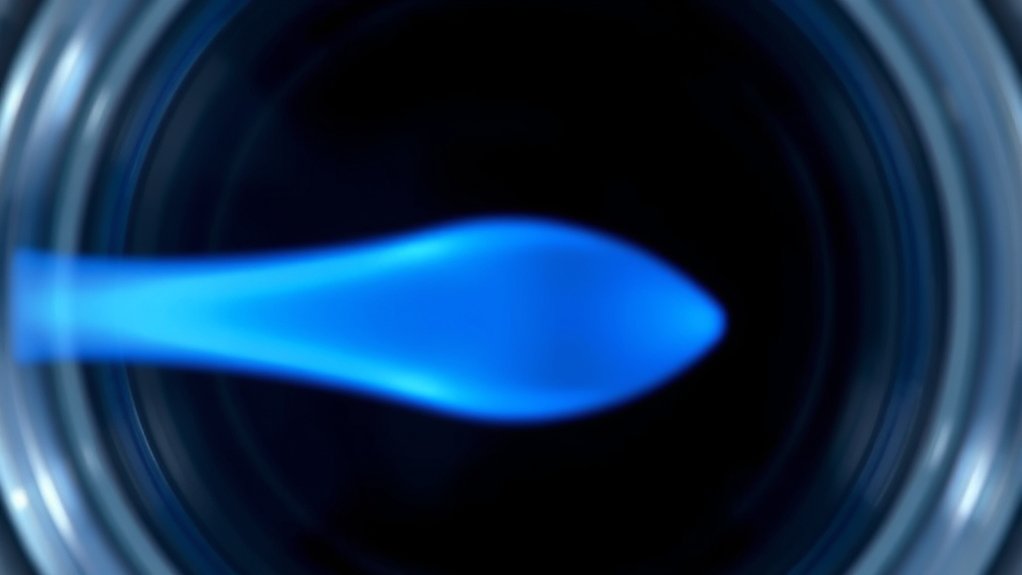
Instead, flames vanish or may appear as small, dim, spherical glows with a faint blue hue.
Without air pressure, flames can’t hold their usual teardrop shape or brightness. Heat and light from the flame drop dramatically, and any flame that forms is unstable and short-lived.
The behavior of flames in a vacuum is drastically different from what we observe on Earth.
If you want to understand why flames behave this way and their impact in space, there’s more to explore. The unique conditions in a vacuum challenge our typical notions of fire and combustion.
Exploring these phenomena reveals fascinating insights about fire science beyond our atmosphere.
Key Takeaways
- Flames in a vacuum extinguish almost instantly due to the absence of oxygen needed for combustion.
- Without air pressure, flames lose their teardrop shape and may appear as small, dim, spherical glows if visible.
- Combustion reactions stop quickly, resulting in faint blue or colorless flames with reduced brightness and heat output.
- Flames lack flickering or dancing motions in vacuum because of the absence of gravity-driven convection and air currents.
- The flame’s instability and rapid extinction reflect the fundamental inability to sustain combustion in oxygen-free environments.
How Does a Flame Normally Behave in Earth’s Atmosphere?
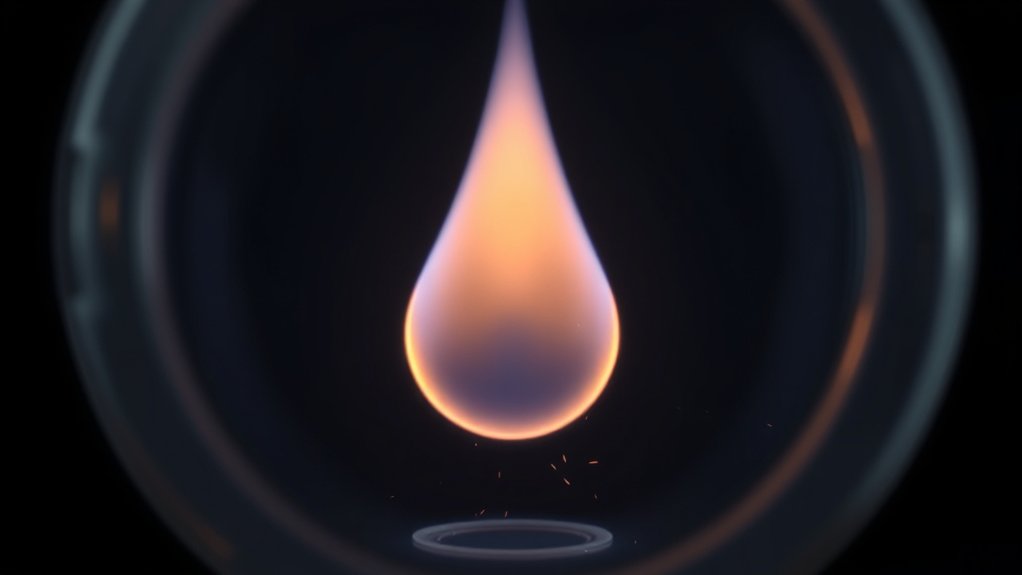
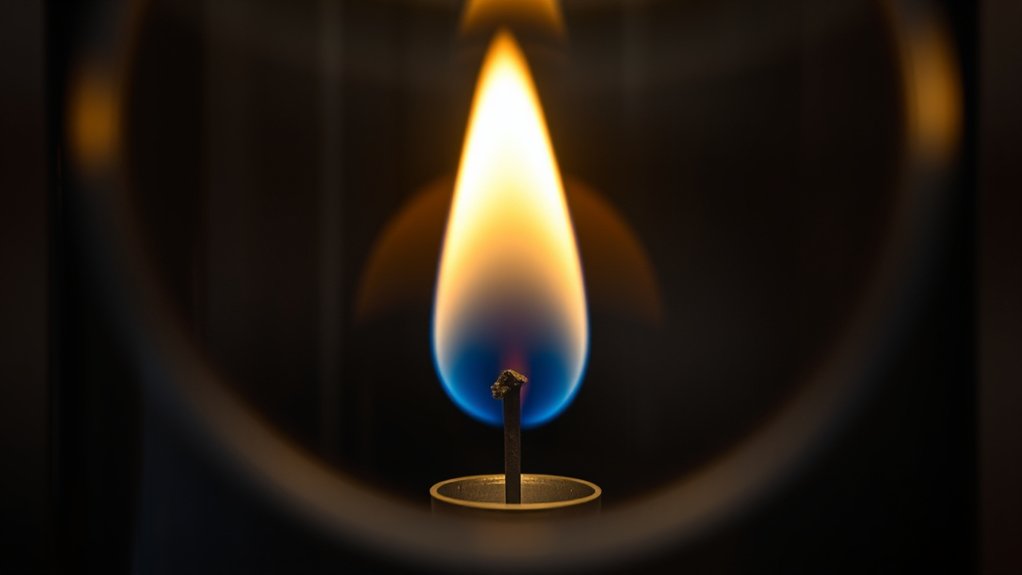
When you light a flame in Earth’s atmosphere, it behaves in a way you might expect: it flickers and dances because oxygen fuels the combustion. You see a bright, yellow-orange glow caused by soot particles heated to glowing temperatures. The flame’s shape forms a teardrop because hot gases rise, pulling fresh oxygen at the bottom.
Inside, the flame has different temperature zones—blue near the base where combustion is more complete, and yellow toward the tip where incomplete combustion creates tiny carbon particles. You notice the flame responds to air currents, flickering or bending as the airflow changes. This dynamic behavior results from the constant interaction between fuel, oxygen, and heat, sustaining the chemical reactions that keep the flame alive and visible to you.
What Happens to Combustion When Air Is Removed?
When you remove air, you’re also taking away the oxygen that fuels combustion. Without enough oxygen, flames can’t stay lit or behave like they do under normal pressure.
You’ll notice that as pressure drops, flame size and intensity change dramatically.
Oxygen’s Role In Combustion
Although you might not realize it, oxygen plays a crucial role in sustaining combustion, and without it, flames simply can’t survive. When you remove air, which contains about 21% oxygen, the fuel lacks the necessary element to react and produce fire.
Here’s what oxygen does for combustion:
- Combines with fuel to release energy as heat and light
- Supports the chemical reactions that keep flames burning
- Helps maintain the flame’s temperature for continuous burning
- Reacts to form combustion byproducts like carbon dioxide and water vapor
- Controls the flame’s size and intensity based on its concentration
Without oxygen, the chemical chain reaction breaks down, and combustion stops. So, when air is removed, you’re fundamentally starving the flame of its life source.
Flame Behavior Without Air
How does a flame behave once you remove the air around it? Without air, a flame can’t survive because it lacks oxygen, a key ingredient for combustion. When you take away the air, the flame quickly dims and goes out.
That’s because combustion is a chemical reaction where oxygen combines with fuel, releasing heat and light. Without oxygen, this reaction stops instantly. Even if fuel and heat remain, the absence of air means no fresh oxygen reaches the flame, so it can’t sustain itself.
In a vacuum, where air is nearly absent, you’ll notice flames extinguish almost immediately. So, when you remove air, you’re fundamentally cutting off the flame’s lifeline, causing it to vanish right before your eyes.
Effects Of Low Pressure
Removing air completely causes flames to go out, but what happens as the air pressure gradually drops? As pressure decreases, the amount of oxygen available for combustion lessens, directly impacting flame behavior. You’ll notice several key effects:
- Flames become smaller and dimmer due to reduced oxygen.
- Combustion slows down, producing less heat.
- Flames may flicker or become unstable.
At very low pressures, flames shift from bright yellow to blue or nearly invisible. Below a certain pressure threshold, flames extinguish entirely.
These changes happen because less oxygen means less fuel burns. So, when you remove air or lower its pressure, expect combustion to weaken and eventually stop. Understanding this helps explain why flames can’t survive in a vacuum or near-vacuum conditions.
How Oxygen Levels Affect Flame Shape and Color
You’ll notice that changing oxygen levels can dramatically alter a flame’s shape and color. When oxygen is plentiful, flames burn brighter and bluer, but lower oxygen makes them dimmer and more yellow.
Understanding these shifts helps you see how combustion adapts in different environments.
Oxygen Concentration Impact
Why does oxygen concentration play such an essential role in the appearance of a flame? Because oxygen fuels combustion, it directly affects how the flame behaves and looks. When oxygen levels change, you’ll notice shifts in flame size, shape, and intensity.
Here’s what happens as oxygen concentration varies:
- Low oxygen causes a smaller, weaker flame that flickers and struggles to sustain itself.
- Higher oxygen levels produce a larger, more stable flame with a defined shape.
- Too little oxygen leads to incomplete combustion and a smoky, irregular flame.
- Ideal oxygen creates a steady, elongated flame that burns cleanly.
- In very high oxygen environments, flames can become hotter and more intense, sometimes changing their shape dramatically.
Understanding oxygen’s impact helps you predict and control flame behavior in different settings.
Flame Color Variations
A flame’s color reveals a lot about the oxygen levels feeding it. When oxygen is abundant, the flame burns blue, indicating complete combustion.
With less oxygen, the flame turns yellow or orange, showing incomplete combustion and soot particles glowing. If oxygen is very low, the flame may flicker weakly or even extinguish.
| Oxygen Level | Flame Color | Combustion Type |
|---|---|---|
| High | Blue | Complete combustion |
| Moderate | Yellow | Partial combustion |
| Low | Orange/Red | Incomplete combustion |
Shape Changes With Oxygen
Although flame color provides key insights into combustion, the shape of a flame also changes noticeably with oxygen levels. When oxygen is plentiful, flames tend to be taller and more defined.
But as oxygen decreases, the flame shortens, flickers, or even shrinks to a dim glow. You’ll notice these effects:
- High oxygen: sharp, elongated flame with blue hues
- Moderate oxygen: flickering, yellow-orange flame
- Low oxygen: weak, small flame with less defined edges
- Near-zero oxygen: flame struggles to sustain, often extinguishing
- Variable oxygen: irregular shape, fluctuating brightness
Understanding these changes helps you grasp how vital oxygen is for flame stability and combustion efficiency.
Why Flames Can’t Sustain Combustion in a Vacuum
Since flames rely on oxygen to keep burning, they can’t survive in a vacuum where air is absent. Without oxygen, the chemical reaction of combustion halts immediately, snuffing out the flame.
Also, in a vacuum, there’s no air pressure to support the flame’s shape or heat distribution, which further stops combustion.
Here’s a quick comparison:
| Factor | In Normal Air | In Vacuum |
|---|---|---|
| Oxygen Availability | Present | None |
| Combustion Process | Sustained | Stops |
| Heat Transfer | Convection & conduction | Minimal |
| Flame Shape | Defined and stable | Nonexistent |
You can see why flames just can’t keep burning when you take away air.
What Flames Look Like in Microgravity and Vacuum Conditions?
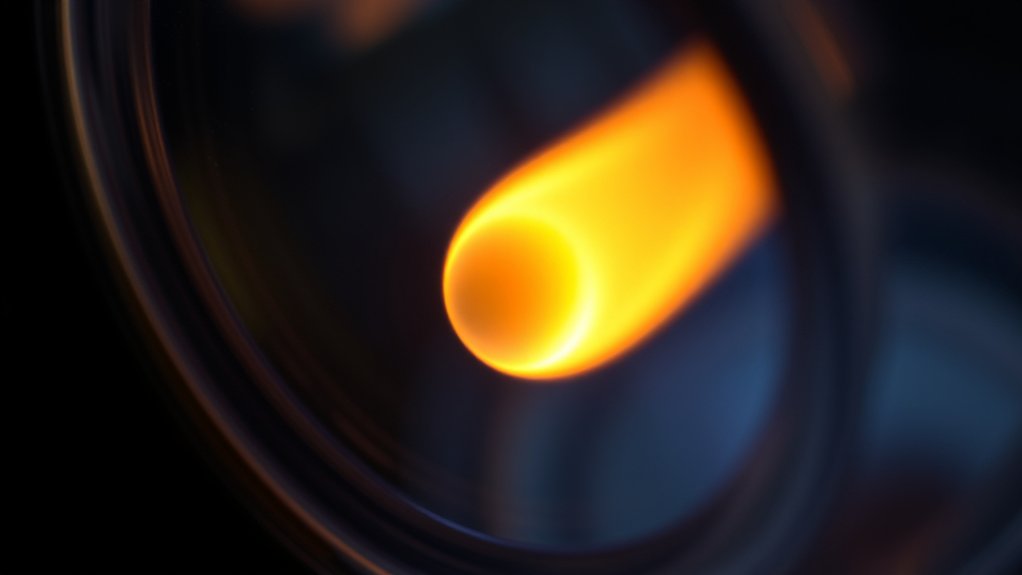
When you observe flames in microgravity or vacuum conditions, you’ll notice they behave very differently from those on Earth. Without gravity pulling hot gases upward, flames don’t stretch or flicker as they do here. Instead, they form almost spherical shapes due to the even diffusion of gases around the flame.
Here’s what you’ll see:
- Flames become round and stable, resembling glowing balls.
- Absence of convection causes slower combustion.
- The flame’s color shifts, often appearing bluer due to efficient burning.
- Soot production decreases since combustion is more complete.
- Flames burn more quietly and steadily without air currents.
These visual changes highlight how gravity and air pressure shape the flames we’re used to, making microgravity flames uniquely mesmerizing.
How Flame Chemistry Changes Without Air Pressure
If you reduce air pressure, the chemical reactions within a flame change dramatically, altering how fuel and oxygen interact. At lower pressures, there are fewer oxygen molecules available to react with the fuel, so combustion becomes less efficient. You’ll notice the flame’s temperature drops because incomplete reactions produce less heat.
This also means you get more soot and unburned fuel particles, causing the flame to appear dimmer or even bluish due to different excited molecules emitting light. Without enough oxygen, the flame struggles to sustain itself and may flicker or extinguish quickly. Additionally, reduced pressure slows down the diffusion of gases, so the mixing of fuel and oxygen becomes less uniform, further affecting combustion stability and flame shape.
Understanding these changes helps you grasp how vital air pressure is for flame chemistry.
What Vacuum Flame Experiments and Space Missions Show Us
You’ve probably wondered how flames behave when there’s almost no air around. Experiments in vacuum chambers and observations from space missions reveal how flames change shape, size, and color without normal atmospheric pressure.
Let’s explore what these findings teach us about fire in extreme environments.
Flame Behavior In Vacuum
Although flames rely on oxygen to burn, their behavior changes dramatically in a vacuum, revealing surprising insights about combustion. When you observe flames in low-pressure or near-vacuum conditions, you’ll notice they don’t flicker or stretch like on Earth. Instead, they form spherical shapes due to the absence of gravity-driven convection currents.
Here’s what vacuum experiments show you about flame behavior:
- Flames shrink as pressure drops, eventually extinguishing without enough oxygen.
- Combustion becomes diffusion-controlled, meaning fuel and oxygen mix slowly.
- Flames emit a faint blue color, indicating lower temperatures.
- Soot production decreases because incomplete combustion is less likely.
- Heat transfer occurs mainly through radiation, not convection.
Understanding these behaviors helps you see how fire behaves beyond Earth’s atmosphere.
Space Mission Observations
How do flames behave during space missions where vacuum conditions prevail? When astronauts conduct combustion experiments aboard the International Space Station, you see flames that don’t flicker like they do on Earth. In microgravity, without convection currents, flames form spherical shapes because hot gases don’t rise.
Space missions have shown that in near-vacuum conditions, flames struggle to sustain themselves, often shrinking or extinguishing quickly due to limited oxygen. Experiments like NASA’s Flame Extinguishment Experiment reveal how fuel burns differently, impacting fire safety protocols in space. By observing these vacuum flame behaviors, you gain insights that help improve spacecraft design and emergency responses.
These observations prove that combustion in space is fundamentally different, forcing you to rethink how fire operates beyond Earth’s atmosphere.
How Flame Heat and Light Emission Change in a Vacuum
When you observe a flame in a vacuum, you’ll notice its heat and light emission behave quite differently than in normal atmospheric conditions. Without enough oxygen and air pressure, the flame struggles to sustain the usual combustion process. This affects both how hot the flame gets and the way it emits light.
In a vacuum, flames struggle without oxygen and pressure, altering their heat and light emission significantly.
Specifically, you’ll see:
- Reduced heat output due to limited oxygen for combustion
- Less vibrant, dimmer light emission compared to flames in air
- A smaller, more spherical flame shape affecting heat distribution
- Altered color spectrum, often shifting toward blue or faint hues
- Lower energy release, making the flame less intense overall
These changes reflect how essential air pressure and oxygen are to maintaining flame intensity and brightness in everyday environments.
Safety Challenges of Flames in Low-Pressure Environments
Since low-pressure environments limit oxygen availability, flames behave unpredictably, creating unique safety hazards you need to understand. In these conditions, flames can become unstable or extinguish suddenly, increasing the risk of accidental flare-ups when oxygen re-enters. You must also consider that incomplete combustion may release toxic gases, posing inhalation dangers.
Traditional fire suppression methods might not work effectively, so you’ll need specialized equipment designed for low-pressure situations. Additionally, the altered flame shape and size can make it harder to monitor and control, raising the potential for burns or equipment damage. Recognizing these risks and preparing accordingly guarantees your safety when working with flames in low-pressure or near-vacuum environments.
How Studying Vacuum Flames Advances Space Exploration
Although flames behave very differently in a vacuum, studying their unique properties helps you design safer and more efficient propulsion systems for spacecraft. Understanding vacuum flames lets you optimize fuel combustion in space, improving rocket engine performance and reducing risks.
By exploring how flames react without atmospheric pressure, you can develop propulsion methods that maximize thrust and fuel efficiency. You can also prevent accidental fires in spacecraft environments and create combustion systems that work reliably in microgravity.
Additionally, studying vacuum flames helps enhance materials and designs resistant to unusual flame behaviors. It informs emergency protocols for space missions involving fire hazards.
This knowledge directly supports safer, more advanced space exploration, ensuring you’re prepared for the challenges of operating in the harsh vacuum of space.
What Future Research Could Reveal About Flames in Space
As researchers continue to explore flames in space, you’ll gain insights that could revolutionize spacecraft safety and propulsion technology. Future studies may uncover how microgravity affects flame shape, temperature, and combustion efficiency, helping you design better fire suppression systems and fuel engines.
Understanding flame behavior in vacuum could also improve life support systems and energy use aboard spacecraft.
Here’s what future research might reveal:
| Research Focus | Potential Impact |
|---|---|
| Flame Shape Dynamics | Safer spacecraft interiors |
| Combustion Efficiency | More efficient propulsion systems |
| Heat Transfer | Improved thermal management |
| Fire Suppression | Enhanced emergency response |
| Fuel Mixture Behavior | Optimized fuel consumption |
Frequently Asked Questions
Can a Flame Exist Without Any Fuel Source?
No, you can’t have a flame without a fuel source because flames need fuel to sustain combustion.
Without fuel, the chemical reaction stops, and the flame goes out immediately since there’s nothing to burn.
How Do Different Gases Affect Flame Behavior in Vacuum?
You’ll find that different gases change flame behavior in a vacuum by altering combustion. Oxygen-rich gases make flames brighter and hotter, while inert gases suppress flames, causing them to flicker or vanish due to limited oxygen availability.
What Materials Can Burn in a Vacuum Environment?
You can’t burn most materials in a vacuum because combustion needs oxygen. However, metals like magnesium or certain chemicals with their own oxidizers can burn, since they don’t rely on atmospheric oxygen to sustain flames.
Are There Practical Applications for Vacuum Flames on Earth?
You won’t find many practical applications for vacuum flames on Earth because they’re unstable without oxygen. However, studying them helps improve combustion efficiency and materials testing in controlled, low-pressure environments, benefiting aerospace and industrial processes.
How Do Vacuum Conditions Impact Flame Noise or Sound?
You won’t hear much flame noise in a vacuum because sound needs air to travel. Without air molecules, the flame’s combustion sounds are nearly silent, making vacuum flames much quieter than those in normal atmospheric conditions.
Conclusion
Just like candlelight flickers softly in a quiet room, a flame in a vacuum struggles to survive without air’s embrace. You see, without oxygen, combustion fades into silence—no dancing colors, no warmth. Understanding this fragile dance not only sparks curiosity but fuels our journey beyond Earth, where mastering fire in space could illuminate new frontiers.
So, as you gaze at a flame, remember—it’s a delicate balance that keeps stars burning, both here and among the cosmos. The behavior of flames in a vacuum highlights the essential role of oxygen in combustion. This knowledge drives our exploration of fire in space, helping us unlock new possibilities in vacuum environments.