How to Understand kPa in Vacuum Measurements
When you measure vacuum pressure in kPa, you are essentially determining how much the pressure inside your system drops below the normal atmospheric pressure, which is approximately 101.3 kPa at sea level.
Understanding kPa in vacuum measurements is crucial for assessing the vacuum’s strength and efficiency. Lower kPa values indicate a stronger vacuum with fewer air molecules present.
This knowledge helps you interpret the vacuum level accurately. Additionally, factors like temperature, calibration, and unit conversions can influence kPa readings.
Being aware of these elements ensures you obtain precise and reliable vacuum pressure measurements every time.
Key Takeaways
- kPa (kilopascal) measures pressure relative to atmospheric pressure, indicating vacuum strength below ambient levels.
- Atmospheric pressure is about 101.3 kPa at sea level; vacuum pressure reflects how much lower it is inside a system.
- Absolute pressure starts from zero (perfect vacuum), while gauge pressure measures relative to current atmospheric pressure.
- Lower kPa values mean a stronger vacuum with fewer gas molecules in the measured space.
- Understanding kPa helps evaluate vacuum efficiency and compare pressure levels using a standardized metric unit.
What Does kPa Mean in Vacuum Measurements?
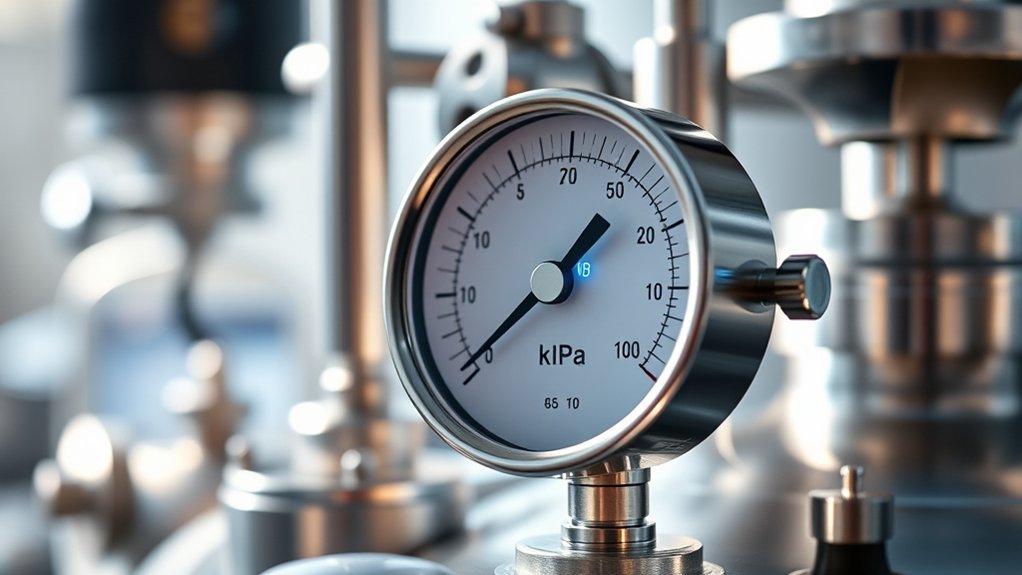
What exactly does kPa represent in vacuum measurements? kPa stands for kilopascal, a unit of pressure that quantifies the force exerted per square meter. When you measure vacuum pressure in kPa, you’re fundamentally gauging how much pressure is below a reference point, often atmospheric pressure.
This measurement helps you understand how strong the vacuum is inside a system. Lower kPa values indicate a stronger vacuum, meaning less air or gas molecules are present. You’ll often see vacuum gauges calibrated in kPa to provide a clear, standardized reading.
How Vacuum Pressure in kPa Differs From Atmospheric Pressure
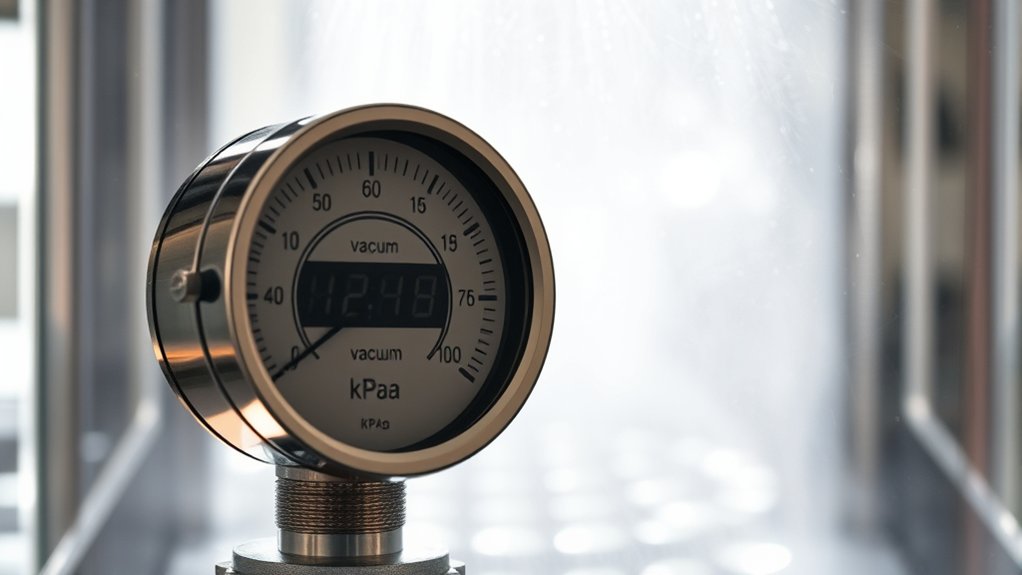
How does vacuum pressure measured in kPa relate to the atmospheric pressure around you? Atmospheric pressure at sea level is about 101.3 kPa, which represents the force exerted by air molecules pressing down on surfaces.
When you measure vacuum pressure in kPa, you’re looking at a value below this atmospheric baseline. Instead of the usual positive pressure pushing down, vacuum pressure indicates how much the pressure has dropped below atmospheric pressure.
For example, if a vacuum gauge reads 20 kPa, it means the pressure inside the system is 20 kPa less than the outside atmospheric pressure. Understanding this difference helps you grasp how much air has been removed or reduced from a space compared to normal conditions.
Why Use kPa to Measure Vacuum?
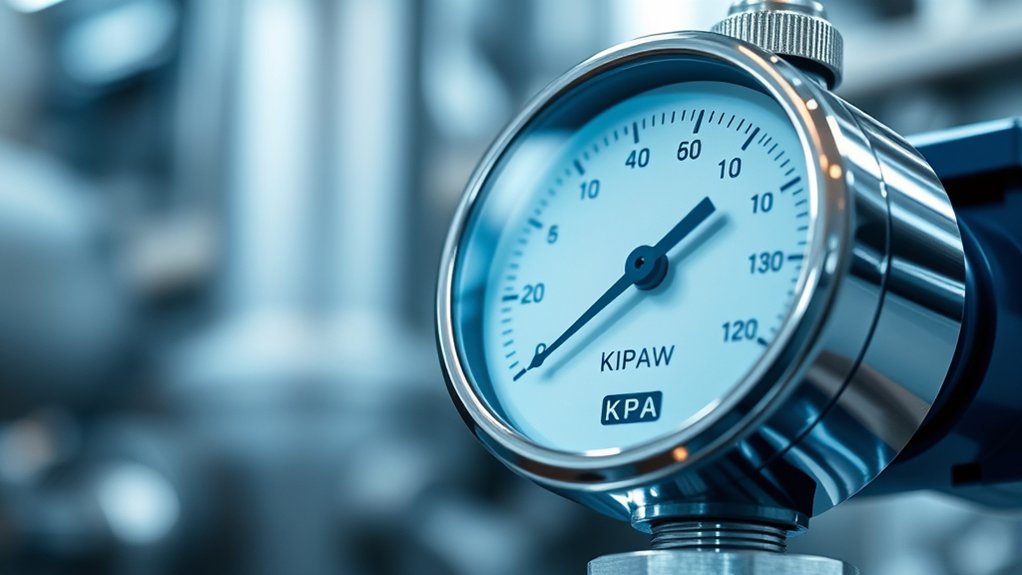
Why choose kPa for measuring vacuum instead of other units? Kilopascals provide a clear, standardized way to express pressure, making it easier for you to compare and understand vacuum levels. Since kPa is part of the metric system, it’s widely accepted internationally, which simplifies communication across industries and regions.
Using kPa also offers precision without overwhelming complexity. Unlike units like torr or psi, kPa directly relates to the SI unit of pressure, Pascal, allowing you to easily convert and calculate values in scientific or engineering contexts. This consistency helps you avoid confusion, especially when working with equipment or documentation that relies on metric measurements.
Understanding Absolute vs. Gauge Pressure in kPa
To accurately read vacuum levels in kPa, you need to understand the difference between absolute and gauge pressure. Absolute pressure measures from a perfect vacuum, while gauge pressure compares to the current atmospheric pressure.
Knowing this helps you interpret your measurements correctly and avoid confusion.
Absolute Pressure Defined
When you measure pressure in kPa, you might wonder what absolute pressure really means compared to gauge pressure. Absolute pressure refers to the total pressure measured relative to a perfect vacuum (zero pressure). It includes atmospheric pressure plus any additional pressure in the system.
This makes it a true measure of pressure, especially important in vacuum applications where pressure can drop below atmospheric levels.
| Term | Definition |
|---|---|
| Absolute Pressure | Pressure relative to a vacuum (0 kPa) |
| Atmospheric Pressure | Pressure exerted by air at sea level (~101.3 kPa) |
| Vacuum Pressure | Pressure below atmospheric pressure |
| kPa (kilopascal) | Unit of pressure measurement |
Understanding absolute pressure helps you accurately assess vacuum levels and system performance.
Gauge Pressure Explained
How do you differentiate gauge pressure from absolute pressure when measuring in kPa? Gauge pressure measures the pressure relative to the surrounding atmospheric pressure, not from a perfect vacuum like absolute pressure does. When you use gauge pressure, zero on the scale corresponds to atmospheric pressure, so it can be positive or negative based on whether pressure is above or below atmospheric levels.
Here’s what you should know about gauge pressure:
- It excludes atmospheric pressure, showing only the pressure difference.
- It’s commonly used in everyday applications like tire pressure.
- Negative gauge pressure indicates a vacuum relative to atmosphere.
- You can convert gauge pressure to absolute pressure by adding atmospheric pressure (about 101.3 kPa at sea level).
Understanding this helps you interpret vacuum readings accurately.
How to Convert kPa to Other Pressure Units
Now that you understand kPa in vacuum measurements, let’s look at how to convert kPa into other common pressure units like psi and bar.
You’ll find simple step-by-step methods to make these conversions easy and accurate.
This will help you compare and work with different measurement systems confidently.
Common Pressure Unit Equivalents
Although kPa (kilopascals) is a common unit for measuring vacuum pressure, you’ll often need to convert it to other units like psi, bar, or Torr to compare readings or work with different equipment. Understanding common pressure unit equivalents helps you interpret measurements accurately and communicate results effectively.
Here are some useful equivalents to keep in mind:
- 1 kPa = 0.145 psi (pounds per square inch)
- 1 kPa = 0.01 bar
- 1 kPa = 7.5 Torr (mmHg)
- 1 kPa = 1000 Pa (pascals)
Knowing these conversions lets you quickly switch between units without confusion or error, especially when dealing with vacuum systems that specify pressure in different formats.
Step-by-Step Conversion Methods
When you need to convert kPa to other pressure units, following a clear, step-by-step method guarantees accuracy and consistency. First, identify the target unit, such as psi, bar, or atm. Next, use the correct conversion factor.
Multiply the kPa value by this factor to get the equivalent pressure. Always double-check your calculations for errors.
Here’s a quick reference table for common conversions:
| Pressure Unit | Conversion Factor (from 1 kPa) |
|---|---|
| psi | 0.145038 |
| bar | 0.01 |
| atm | 0.009869 |
| mmHg | 7.50062 |
Use this table to simplify your conversions and assure precise vacuum measurement readings.
Reading Vacuum Gauges Displayed in kPa
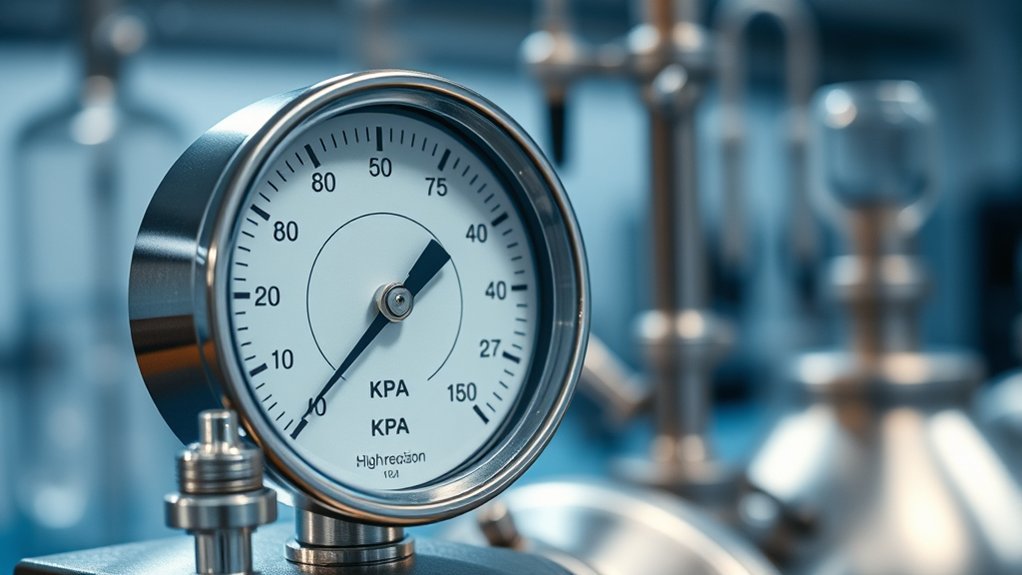
Since vacuum gauges often display measurements in kilopascals (kPa), understanding how to read these values accurately is essential for monitoring pressure levels. When you look at a vacuum gauge in kPa, you’re seeing the absolute or gauge pressure relative to atmospheric pressure.
To correctly interpret these readings, keep these points in mind:
- Check if the gauge shows absolute pressure (0 kPa = perfect vacuum) or gauge pressure (0 kPa = atmospheric pressure).
- Note the scale increments to understand the resolution and precision.
- Remember that lower kPa values indicate stronger vacuum levels.
- Compare readings over time to detect leaks or system changes.
Common Applications Using kPa for Vacuum
You’ll encounter kPa vacuum measurements in many industries where precise pressure control is crucial. For example, in manufacturing, vacuum packaging uses kPa readings to ensure airtight seals, preserving product freshness. In automotive applications, vacuum systems rely on kPa values to maintain proper engine performance and emissions control.
Scientific laboratories use kPa measurements to monitor vacuum levels during experiments, guaranteeing accurate results. Medical equipment, such as suction devices, also depends on kPa readings to operate safely and effectively. Even HVAC systems employ vacuum measurements in kPa to detect leaks and maintain system efficiency.
How Temperature Changes Affect kPa Vacuum Readings
Understanding how temperature impacts kPa vacuum readings can help you maintain accuracy in the applications we’ve discussed. Temperature fluctuations affect the density and pressure of gases inside your vacuum system, causing variations in kPa readings. If you overlook these changes, your measurements may be off.
Here’s what you should keep in mind:
- Gas expands when heated, increasing pressure and kPa values.
- Cooling causes gas contraction, lowering pressure and vacuum readings.
- Sensor components themselves may react to temperature, affecting output.
- Consistent temperature conditions lead to more reliable kPa measurements.
Practical Tips for Accurate Calibration of Vacuum Sensors in kPa
When calibrating vacuum sensors in kPa, paying close attention to detail guarantees your readings stay accurate and reliable. Start by guaranteeing the calibration environment is stable—temperature fluctuations can skew results. Use a high-quality, traceable standard vacuum source for comparison.
Before calibration, let your sensor warm up fully to stabilize its output. Always follow the manufacturer’s recommended calibration procedure and record each step meticulously. Avoid over-tightening fittings, which may cause leaks and affect accuracy.
Check for and eliminate any air leaks in the system. Perform multiple calibration cycles to confirm consistency. Finally, regularly recalibrate your sensors to maintain precision over time.
Interpreting Negative kPa Values in Vacuum
Although negative kPa values might seem confusing at first, they play an essential role in vacuum measurements by indicating pressure levels below atmospheric pressure. When you see a negative kPa reading, it means the vacuum system is creating a pressure lower than the surrounding atmosphere, which is vital for many applications.
Here’s what you should keep in mind when interpreting negative kPa values:
- Negative values show how much pressure is reduced relative to atmospheric pressure.
- The more negative, the stronger the vacuum.
- Zero kPa corresponds to atmospheric pressure, so negative values are always below that baseline.
- Understanding these values helps you assess vacuum strength and system performance accurately.
Troubleshooting Inaccurate kPa Vacuum Readings
If your kPa vacuum readings seem off, start by checking for common measurement errors that could be causing the issue. Make sure your equipment is properly calibrated to avoid inaccurate data.
Also, consider environmental factors like temperature and humidity that might interfere with your readings.
Common Measurement Errors
Mistakes in vacuum measurements often stem from simple oversights that you can easily fix. When your kPa readings seem off, start by checking these common errors:
- Improper sensor placement: Make sure the sensor is correctly positioned to avoid false readings.
- Leaks in the system: Even small leaks can cause inaccurate vacuum levels; inspect seals and connections.
- Dirty or damaged sensors: Contaminants or wear can disrupt sensor function, so clean or replace as needed.
- Incorrect unit settings: Verify that your device is set to measure in kPa, not another unit like psi or mmHg.
Equipment Calibration Checks
When your kPa vacuum readings don’t match expectations, checking your equipment’s calibration is a crucial next step. Calibration ensures your instrument measures pressure accurately and helps identify faulty sensors or drift over time.
To perform a calibration check, compare your device’s reading against a known standard or reference gauge under controlled conditions. Document any deviations and recalibrate if necessary.
| Step | Action | Purpose |
|---|---|---|
| 1. Reference Check | Use a certified gauge | Confirm baseline accuracy |
| 2. Compare Readings | Measure vacuum with both devices | Detect discrepancies |
| 3. Adjust & Record | Calibrate instrument if needed | Maintain measurement precision |
Regular calibration checks keep your vacuum measurements reliable and trustworthy.
Environmental Interference Factors
Although you’ve calibrated your equipment, environmental factors can still cause inaccurate kPa vacuum readings. These interferences can distort measurements, leading to faulty data that affects your processes.
To minimize these errors, watch out for:
- Temperature fluctuations: Changes can affect sensor sensitivity and air density.
- Humidity levels: Excess moisture may cause condensation or electrical interference.
- Vibration and mechanical noise: Nearby machinery can disrupt sensor stability.
- Electromagnetic interference (EMI): Signals from other devices can skew readings.
Choosing the Right Vacuum Gauge for kPa Measurement
How do you pick the right vacuum gauge to accurately measure pressure in kilopascals (kPa)? First, consider the pressure range you need to measure. Different gauges excel at various ranges—some are better for low vacuum (high kPa values), while others work best in high vacuum (low kPa values).
Next, assess the gauge’s accuracy and resolution to ensure your readings are reliable. You should also think about the gauge’s compatibility with your system’s environment, such as temperature and chemical exposure. Digital gauges often provide easier kPa readings with better precision.
Finally, check the gauge’s response time and maintenance requirements to match your application’s needs. By evaluating these factors, you’ll choose a vacuum gauge that fits your specific kPa measurement needs effectively.
Best Practices for Maintaining Vacuum Systems Measured in kPa
Selecting the right vacuum gauge sets the foundation for accurate kPa measurements, but maintaining your vacuum system guarantees those readings stay consistent over time. To keep your system reliable, focus on routine upkeep and careful handling. Regularly check for leaks and replace worn seals to prevent pressure loss.
Clean your gauges and sensors to avoid contamination that can skew readings. Ascertain all connections remain tight and inspect hoses for cracks or damage. Finally, calibrate your gauges periodically to maintain accuracy.
Follow these best practices:
- Inspect and replace faulty seals or O-rings promptly
- Clean sensors and gauges regularly
- Tighten fittings and check hoses for wear
- Schedule routine calibration and system checks
Frequently Asked Questions
How Does Altitude Affect kPa Vacuum Measurements?
Altitude lowers atmospheric pressure, so you’ll see lower kPa readings in vacuum measurements at higher elevations.
You’ve got to adjust your vacuum gauge readings to account for this change to guarantee accurate pressure assessments.
Can Humidity Impact Vacuum Readings in kPa?
Humidity’s like a sneaky fog, and yes, it can impact your vacuum readings in kPa. Moisture changes air density, messing with pressure measurements.
You’ll want to account for humidity to keep your readings accurate and reliable.
What Materials Resist Corrosion in kPa Vacuum Environments?
You’ll want to choose stainless steel, aluminum, or titanium since they resist corrosion well in kPa vacuum environments. These materials stand up to moisture and chemical exposure, keeping your equipment durable and reliable over time.
How Often Should Vacuum Gauges Be Recalibrated?
Picture a clock ticking steadily—vacuum gauges should be recalibrated every six to twelve months to keep measurements sharp.
If you notice drift or unusual readings, don’t wait; recalibrate immediately to guarantee accuracy and reliability.
Are Digital or Analog Gauges Better for kPa Vacuum Measurement?
You’ll find digital gauges better for kPa vacuum measurement because they offer more precise readings and easier data logging. However, analog gauges are durable and simple, so choose based on your accuracy needs and environment.
Conclusion
Understanding kPa in vacuum measurements isn’t just about numbers; it’s about grasping the invisible forces at work. When you measure vacuum in kPa, you’re decoding a pressure language that speaks volumes about your system’s health.
Remember, whether it’s absolute or gauge pressure, these values guide your decisions. So, don’t let confusing units cloud your judgment—embrace kPa, and you’ll keep your vacuum systems running smoothly, like a well-conducted symphony.
By understanding kPa in vacuum measurements, you gain clarity and control. This knowledge is key to maintaining optimal performance and ensuring accurate pressure readings. Embrace kPa, and enhance your vacuum system’s reliability and efficiency.