What Is the Speed of Electromagnetic Waves in a Vacuum?
You know that electromagnetic waves in a vacuum travel at exactly 299,792,458 meters per second—that’s the universal speed limit for all light and signals.
This speed of electromagnetic waves in a vacuum is constant for every observer and underpins key physics theories like relativity. Understanding this fundamental speed reveals much about the universe’s nature.
It also affects many technologies you use daily, like GPS and communication systems. The unchanging speed of electromagnetic waves is crucial for the science behind modern measurement methods.
This constant speed helps ensure accuracy and reliability in various scientific and technological applications.
Key Takeaways
- Electromagnetic waves travel at a constant speed of 299,792,458 meters per second in a vacuum.
- This speed is universal and independent of the wave’s frequency or energy.
- The speed equals 1 divided by the square root of vacuum permittivity times vacuum permeability (1/√(ε₀μ₀)).
- It is the ultimate speed limit for information and energy transfer in the universe.
- This constant underpins fundamental physics theories like relativity and defines the meter internationally.
What Is the Exact Speed of Electromagnetic Waves in a Vacuum?
Although you might have heard that light travels incredibly fast, the exact speed of electromagnetic waves in a vacuum is precisely 299,792,458 meters per second. You can think of this as the universal speed limit, applying not just to visible light but to all electromagnetic waves, including radio waves, microwaves, and X-rays. This speed is constant and does not vary with the wave’s frequency or energy.
When you consider how far this speed takes you, it means light can circle Earth almost 7.5 times in just one second. This precise value is fundamental in physics, helping you understand concepts in relativity and quantum mechanics. Remember, this speed only holds in a vacuum, where no particles interfere with the wave’s travel.
How Was the Speed of Light First Measured?

You’ll find that the speed of light wasn’t always known with precision. Early experiments laid the groundwork, with Fizeau’s method providing the first practical measurement.
Then, Foucault improved on this approach, refining our understanding even further.
Early Experiments Overview
Before scientists could accurately determine the speed of light, they had to develop clever methods to measure something so fast it seemed instantaneous. Early attempts began in the 17th century when Galileo tried using lanterns on distant hills, but human reaction times made results unreliable. Later, Ole Rømer observed Jupiter’s moons and noticed timing variations in their eclipses, concluding light took time to travel, providing the first quantitative estimate.
These observations marked a turning point, shifting the idea of light as instantaneous to measurable. Then, scientists refined experiments using rotating mirrors and other mechanical setups to better capture light’s speed. You can see how these early experiments laid the groundwork for more precise measurements, showing both creativity and persistence in tackling this fundamental challenge.
Fizeau’s Method Explained
Building on earlier efforts to measure light’s speed, Hippolyte Fizeau introduced a groundbreaking approach in 1849. You’d set up a light source aimed at a rotating toothed wheel. The light passes through the gaps in the wheel’s teeth, travels to a distant mirror, and reflects back.
If the wheel spins at just the right speed, the returning light is blocked by the next tooth, preventing it from reaching you. By adjusting the wheel’s rotation rate until the light is fully blocked, you can calculate the time it takes for light to make the round trip. Knowing the distance to the mirror, you divide by the measured time to find light’s speed.
This clever method was the first practical way to measure light’s velocity on Earth.
Foucault’s Improvement Details
Although Fizeau’s method was revolutionary, Léon Foucault refined the process in 1862 to achieve greater accuracy. Instead of using a toothed wheel, Foucault employed a rotating mirror to measure light’s speed. You’ll find this method more precise because the rotating mirror changes the light beam’s reflection angle depending on its speed.
When the light reflects off the spinning mirror, it travels to a fixed mirror and back. By measuring the small shift in the returning light’s angle caused by the mirror’s rotation, you can calculate how fast light travels. Foucault’s setup reduced mechanical limitations and improved timing precision.
This clever tweak made the speed of light measurement more reliable and paved the way for modern experiments using lasers and mirrors.
How Is the Speed of Electromagnetic Waves Defined and Standardized?
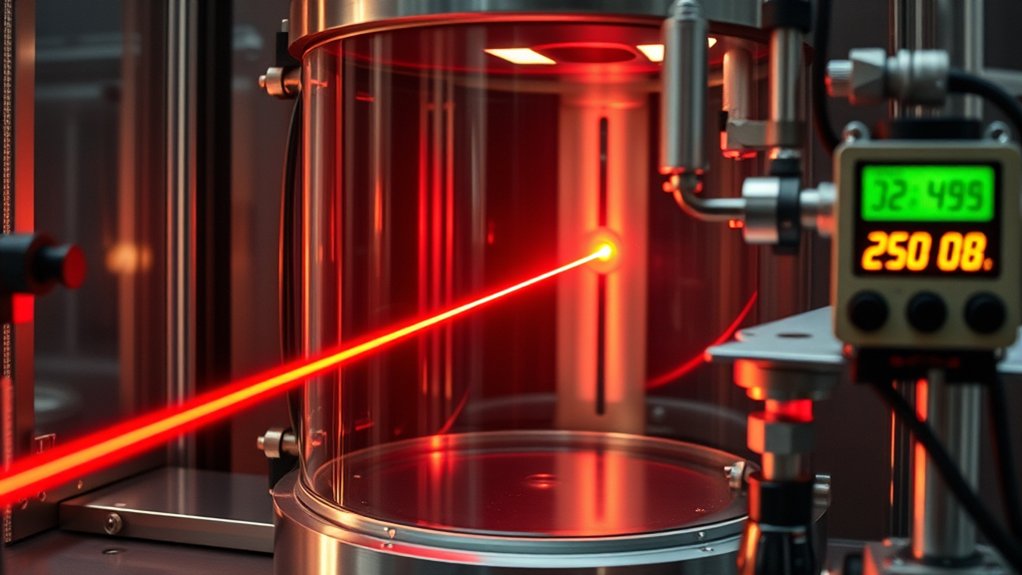
You’ll find that the speed of electromagnetic waves is defined through precise measurement methods using advanced technology. International organizations then set strict standards to guarantee consistency worldwide.
Let’s explore how these measurements work and how the speed is officially standardized.
Measurement Methods Explained
Because the speed of electromagnetic waves is fundamental to physics and technology, scientists have developed precise methods to measure and define it. You can use time-of-flight techniques, where pulses of electromagnetic waves travel a known distance, and you measure the time taken to calculate speed. Interferometry is another method, comparing wave phases to determine speed with extreme accuracy.
You’ll also find cavity resonance experiments, which involve measuring frequencies of standing waves inside a cavity, indirectly giving you the wave speed. Modern approaches often combine these methods for cross-verification, ensuring high precision. By relying on physical constants, these measurements have become so accurate that the speed of light is now fixed, making it a cornerstone for defining units and ensuring consistency across scientific fields.
International Standards Overview
How exactly is the speed of electromagnetic waves defined and standardized across the globe? International organizations like the International Bureau of Weights and Measures (BIPM) have set the speed of light in a vacuum as exactly 299,792,458 meters per second. This value isn’t measured but defined, making the meter itself dependent on this constant.
By fixing this speed, you get a universal standard that scientists and engineers worldwide rely on for accurate measurements and calculations. This standardization ensures consistency in scientific research, telecommunications, and navigation systems.
You’ll find that this agreed-upon speed serves as a fundamental constant in physics, allowing you to work confidently with electromagnetic wave properties regardless of where you are on Earth.
How Does Electromagnetic Wave Speed Relate to Maxwell’s Equations?
When you explore Maxwell’s equations, you’ll see they directly determine the speed at which electromagnetic waves travel through a vacuum. These four equations link electric and magnetic fields, showing how changes in one generate the other. By combining them, you get a wave equation describing electromagnetic waves moving through space.
The wave’s speed emerges from the vacuum’s electric permittivity (ε₀) and magnetic permeability (μ₀), fundamental constants in Maxwell’s framework. Specifically, the speed equals 1 divided by the square root of the product of ε₀ and μ₀. This reveals that electromagnetic wave speed isn’t arbitrary—it’s rooted in the vacuum’s electromagnetic properties dictated by Maxwell’s equations.
Understanding this connection helps you grasp why light and other electromagnetic waves move at precisely this speed in a vacuum.
Why Is the Speed of Light a Universal Constant?
Although you might expect the speed of light to vary depending on your motion or surroundings, it remains constant in a vacuum for all observers. This constancy arises because light’s speed is tied to fundamental properties of space itself. No matter how fast you move or where you are, light’s speed doesn’t change, ensuring consistent physical laws everywhere.
Here’s a quick comparison to clarify:
| Property | Light Speed (Vacuum) | Everyday Speeds |
|---|---|---|
| Speed | 299,792,458 m/s | Varies |
| Dependence on observer | None | Depends |
| Medium needed | No | Often yes |
| Variation with motion | None | Yes |
| Basis | Physical constants | Relative motion |
This unchanging speed anchors much of modern physics.
Why Does Electromagnetic Wave Speed Matter in Physics?
You rely on the speed of electromagnetic waves as a fundamental constant that shapes how physics works. It affects everything from how we understand the universe to how your smartphone communicates. Comprehending this speed helps you appreciate the technology and science that power your daily life.
Fundamental Constant Significance
Because the speed of electromagnetic waves in a vacuum is a fundamental constant, it serves as a cornerstone for many areas of physics. You rely on this constant, denoted as c, to unify theories and make accurate predictions. It sets the ultimate speed limit for information and energy transfer, shaping your understanding of causality and the structure of space-time.
Without this fixed speed, the laws of physics would lose their consistency, making it impossible to reconcile electromagnetism with relativity. You also find that constants like the fine-structure constant depend on this speed, linking it to the strength of electromagnetic interactions. In short, the speed of light isn’t just a number—it’s a crucial key to revealing the universe’s fundamental principles.
Impact On Modern Technology
How does the speed of electromagnetic waves in a vacuum impact the technology you use every day? It guarantees that signals in your smartphone, Wi-Fi, and GPS travel at a predictable, constant speed, enabling quick and accurate communication. This speed underpins the design of everything from fiber-optic networks to satellite transmissions, allowing devices to sync and respond instantly.
Without knowing this speed precisely, engineers couldn’t optimize data transfer rates or maintain signal integrity. It also matters in medical imaging technologies like MRI, where electromagnetic waves create detailed pictures. By understanding this constant speed, you get reliable, efficient technology that powers modern life, from streaming videos to navigating cities, making your daily activities smoother and more connected.
What Role Does Electromagnetic Wave Speed Play in Relativity?
Since electromagnetic waves always travel at a constant speed in a vacuum, this speed becomes a fundamental limit in the theory of relativity. When you understand this, several key points become clear:
Electromagnetic waves travel at a constant speed in vacuum, establishing a fundamental limit in relativity.
- Nothing can exceed the speed of light, setting a universal speed limit.
- Time and space adjust relative to how fast you move, preserving this speed.
- Mass increases as you approach light speed, requiring infinite energy to reach it.
- Causality is maintained because signals can’t travel faster than light, preventing paradoxes.
What Factors Affect Electromagnetic Wave Speed in Different Media?
When electromagnetic waves pass through different materials, their speed changes depending on the properties of those materials. You’ll notice that factors like the material’s permittivity and permeability directly impact wave speed. Permittivity measures how a material responds to electric fields, while permeability relates to magnetic fields.
When either property increases, the wave slows down. Additionally, the material’s density and atomic structure can influence how waves propagate, causing variations in speed. Temperature can also play a role by slightly altering these properties, though its effect is usually minimal.
Understanding these factors helps you predict how electromagnetic waves behave outside a vacuum, highlighting why light travels faster in air than in water or glass. This knowledge is essential for fields like optics and telecommunications.
What Happens When Electromagnetic Waves Travel Through Materials?
As electromagnetic waves enter different materials, you’ll notice their speed and behavior change due to interactions with the atoms and molecules inside. Here’s what happens:
1. The waves slow down because they’re absorbed and re-emitted by particles in the material. 2. Their wavelength shortens while frequency stays the same, altering the wave’s appearance. 3. Some energy might be absorbed, causing the wave to weaken or change direction.
4. Depending on the material’s properties, waves can reflect, refract, or even scatter.
These effects depend on the material’s density and electromagnetic properties, which influence how much the wave’s speed decreases. So, as you observe waves moving through glass, water, or air, you’ll see these changes in action, shaping how we experience light and other electromagnetic radiation daily.
How Has Measuring Electromagnetic Wave Speed Revolutionized Communication?
Understanding the speed of electromagnetic waves has transformed how we communicate by enabling technologies that transmit information almost instantaneously across vast distances. When scientists precisely measured this speed, they discovered the key to radio, television, and mobile networks to send signals quickly and reliably.
You benefit daily from this knowledge when you make phone calls, stream videos, or browse the internet, all relying on electromagnetic waves traveling at light speed. Without knowing this speed, engineers couldn’t design the antennas, satellites, or fiber optic systems that form the backbone of modern communication.
Measuring electromagnetic wave speed also laid the groundwork for global connectivity, allowing messages to cross continents and oceans in mere moments. This breakthrough fundamentally changed how you connect with others and access information worldwide.
How Do Speed Variations Affect GPS and Fiber Optic Technologies?
Although electromagnetic waves travel incredibly fast, slight variations in their speed can considerably impact technologies like GPS and fiber optics. When you rely on these systems, even tiny delays matter.
- GPS signals slow down as they pass through the atmosphere, causing errors in position calculations.
- Fiber optic cables have a refractive index causing light pulses to travel slower than in a vacuum, affecting data timing.
- Speed variations can lead to signal distortion, reducing the accuracy and efficiency of data transmission.
- Engineers must compensate for these delays to maintain precise synchronization and reliable communication.
How Do Modern Instruments Measure Electromagnetic Wave Speed?
When you want to measure the speed of electromagnetic waves, modern instruments rely on precise timing and controlled environments to capture how fast these waves travel. You typically use devices like oscilloscopes, lasers, and time-of-flight systems to track wave propagation over known distances.
Here’s a simple overview:
| Instrument | Method | Accuracy |
|---|---|---|
| Oscilloscope | Measures time intervals | Nanoseconds |
| Laser Interferometer | Measures phase shifts | Picoseconds |
| Time-of-Flight System | Measures travel time | Picoseconds to femtoseconds |
How Does Understanding Electromagnetic Wave Speed Help Us Explore the Universe?
Because electromagnetic waves travel at a constant speed in a vacuum, you can use them as reliable cosmic messengers to study distant stars, galaxies, and other celestial phenomena. This understanding helps you:
- Calculate distances in space by measuring the time light takes to reach you.
- Analyze the composition of celestial bodies through their emitted electromagnetic spectra.
- Observe cosmic events like supernovae and black hole activity in real-time.
- Test fundamental physics theories by comparing predicted and observed wave behaviors.
Frequently Asked Questions
Can Electromagnetic Waves Travel Faster Than Light in a Vacuum?
No, electromagnetic waves can’t travel faster than light in a vacuum. You’ll find that the speed of light is the universal speed limit, so all electromagnetic waves move at that constant speed, never exceeding it.
What Types of Electromagnetic Waves Exist Beyond Visible Light?
You’ll find electromagnetic waves beyond visible light include radio waves, microwaves, infrared, ultraviolet, X-rays, and gamma rays. Each type has different wavelengths and energies, affecting how you use or detect them in daily life or technology.
How Do Electromagnetic Waves Interact With Magnetic Fields?
You’ll see electromagnetic waves dance gracefully with magnetic fields, twisting and turning as they move. They don’t get trapped but influence each other’s paths, creating a delicate, invisible ballet of energy and force around you.
Are There Practical Applications of Electromagnetic Waves in Medicine?
Yes, you’ll find electromagnetic waves essential in medicine. You use them in X-rays, MRI scans, and radiation therapy to diagnose and treat diseases, improving accuracy and patient outcomes every day in healthcare settings worldwide.
How Do Antennas Transmit and Receive Electromagnetic Waves?
You transmit electromagnetic waves by applying an electric current to an antenna, creating oscillating fields. To receive, your antenna captures these waves, converting them back into electrical signals your device processes for communication or data transfer.
Conclusion
You’ve seen how the speed of electromagnetic waves in a vacuum—exactly 299,792,458 meters per second—shapes our understanding of the universe. Remember, “time and tide wait for no man,” and neither does light. Its constant speed not only grounds physics but also powers your GPS and communications daily.
By mastering this speed, you’re tapping into the very fabric of reality, revealing endless possibilities and helping humanity reach further than ever before. The speed of electromagnetic waves in a vacuum is fundamental to modern technology and scientific discovery. Understanding this constant enables advancements in fields like telecommunications, astronomy, and quantum physics.