How to Understand if Space Is a Perfect Vacuum
You might think space is a perfect vacuum, but it’s not completely empty. In fact, space is a very low-density environment filled with tiny particles like hydrogen, helium, and dust.
Cosmic radiation constantly bombards this area, adding to its complex nature.
Magnetic fields and solar winds also influence space’s vacuum quality.
While space is vastly emptier than Earth’s atmosphere or even lab vacuums, it still contains some matter.
Understanding these factors is key to grasping how space functions as a vacuum.
If you want to learn how these elements affect space and spacecraft, there’s plenty more to explore.
The concept of a perfect vacuum in space is nuanced and fascinating.
Key Takeaways
- Space is not a perfect vacuum because it contains residual atoms, molecules, and cosmic radiation particles.
- The vacuum quality varies by region, with deep space having a lower particle density than near planets or stars.
- Cosmic rays and solar winds introduce charged particles and radiation, affecting the vacuum’s purity and dynamics.
- Particle density in space is extremely low, typically ranging from 1 to 1,000 particles per cubic centimeter.
- Measuring vacuum quality uses instruments like residual gas analyzers, ionization gauges, and mass spectrometers.
What Does It Mean for Space to Be a Perfect Vacuum?
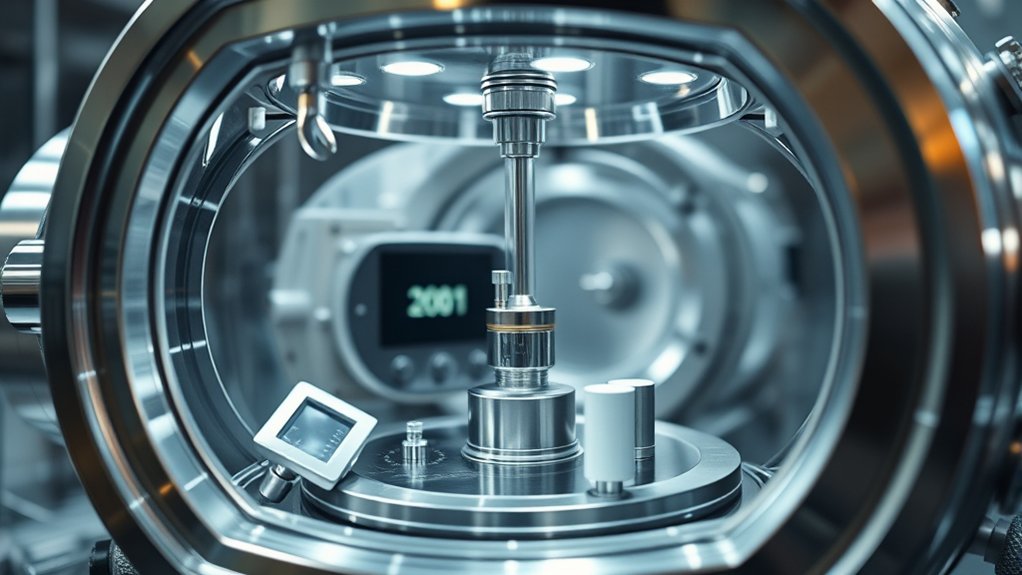
What exactly does it mean to say space is a perfect vacuum? When you hear this, it means space has no matter at all—no air, no particles, nothing to carry sound or support life as you know it. You’re imagining a place completely empty, where molecules don’t exist to interfere with light or movement.
In a perfect vacuum, you wouldn’t find any atoms, gases, or dust floating around. It’s the ultimate emptiness, a space devoid of physical substance. This concept helps you understand how conditions differ from Earth’s atmosphere, where air and particles are everywhere.
Why Isn’t Space a True Vacuum?
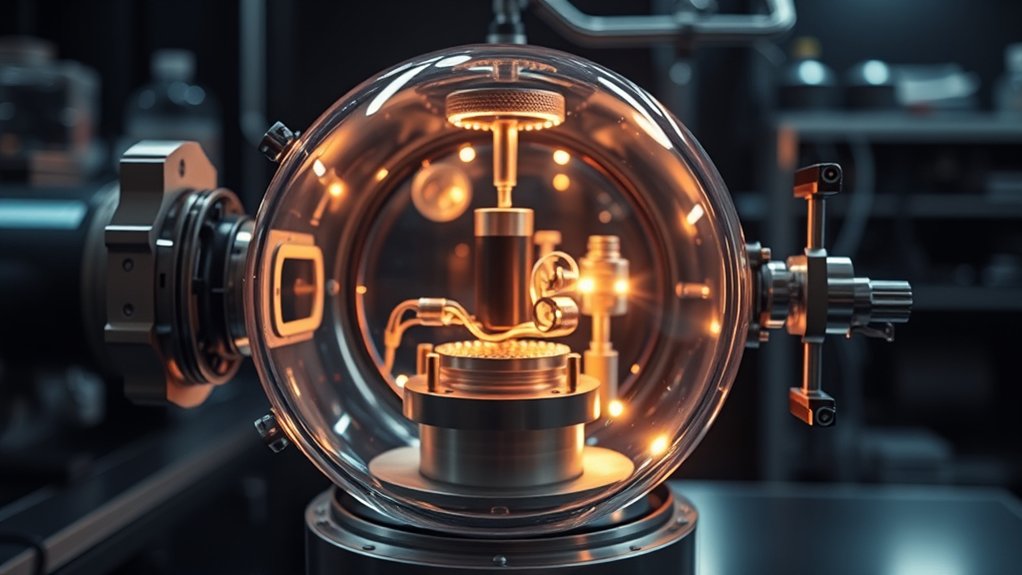
You might think space is completely empty, but it actually contains tiny residual particles scattered throughout. These particles, along with cosmic radiation, prevent space from being a true vacuum.
Let’s explore how these factors affect the emptiness of space.
Residual Particles Presence
Why does space, often described as a vacuum, still contain particles? Even in the vast emptiness between stars, you’ll find stray atoms and molecules floating around. These residual particles come from various sources, like outgassing from planets, comet tails, or remnants of stellar winds.
Although space is incredibly sparse compared to Earth’s atmosphere, it’s never completely empty. You might think a vacuum means zero matter, but in reality, there’s always some trace of particles present. These tiny bits of matter prevent space from being a perfect vacuum.
Cosmic Radiation Effects
Countless high-energy particles, known as cosmic radiation, constantly bombard space, preventing it from being a perfect vacuum. These particles come from distant stars, supernovae, and even our sun, filling space with invisible energy. When you consider cosmic radiation, you realize space isn’t empty—it’s alive with charged particles that interact with spacecraft and astronauts.
This radiation can damage electronics and pose health risks, reminding you that space’s emptiness isn’t absolute.
| Radiation Source | Particle Type | Impact on Space Missions |
|---|---|---|
| Distant Stars | Protons, Nuclei | Equipment degradation |
| Supernovae | High-energy ions | Increased shielding needs |
| Solar Wind | Electrons, Protons | Astronauts’ health risks |
| Galactic Center | Cosmic Rays | Communication interference |
What Particles Exist in Space’s Vacuum?
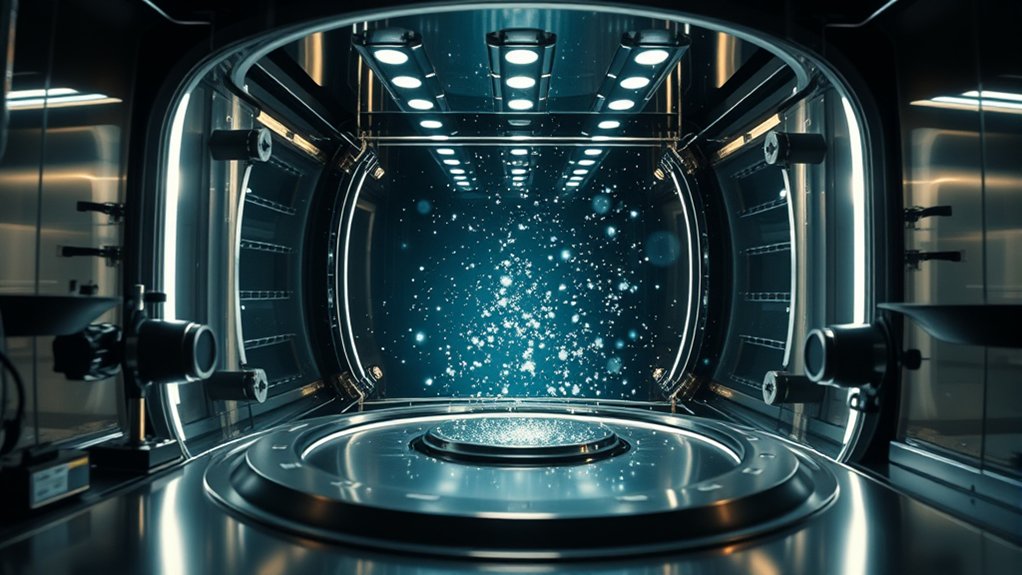
Although space is often described as a vacuum, it still contains a surprising variety of particles. You’ll find stray atoms, mostly hydrogen and helium, drifting through the vast emptiness. These are remnants from the Big Bang and stellar processes.
Besides these neutral atoms, charged particles like protons and electrons also float around, especially in regions influenced by solar winds. You might also encounter tiny dust grains and cosmic rays, which are high-energy particles from distant astrophysical sources. Even in the emptiest parts of space, these particles aren’t completely absent.
Understanding their presence helps you realize that space’s vacuum isn’t a perfect void but a sparse environment filled with low-density particles that influence everything from spacecraft operations to astrophysical phenomena.
How Cosmic Radiation Influences Space Vacuum
How does cosmic radiation affect the vacuum of space you often think of as empty? Cosmic radiation constantly bombards space, introducing high-energy particles that slightly alter its vacuum state. These particles can ionize residual gas molecules, creating charged particles and affecting local space environments.
This means the vacuum isn’t entirely empty but contains energetic influences that impact spacecraft and instruments.
| Radiation Type | Effect on Vacuum |
|---|---|
| Galactic Cosmic Rays | Introduce high-energy ions |
| Solar Cosmic Rays | Cause ionization of gases |
| Neutrinos | Pass through with minimal effect |
| Photons (Gamma Rays) | Add energy, can ionize particles |
Understanding these effects helps you grasp why space’s vacuum isn’t perfectly empty but influenced by cosmic radiation’s dynamic presence.
How Magnetic Fields Change Space Vacuum Conditions
You might not realize it, but magnetic fields can actually influence the vacuum of space around you. These fields cause subtle fluctuations that challenge the idea of a perfect vacuum.
Let’s explore how this magnetic influence changes space vacuum conditions.
Magnetic Influence on Vacuum
Have you ever wondered how magnetic fields can alter the nature of the vacuum in space? When strong magnetic fields permeate a vacuum, they influence the behavior of charged particles and virtual particles that briefly pop in and out of existence. These fields can change the vacuum’s energy density and affect how particles interact within it, effectively modifying the vacuum’s properties.
For instance, magnetic fields can cause vacuum polarization, where the vacuum behaves like a medium with electric and magnetic responses. This means space isn’t just empty—it reacts dynamically to magnetic influences. Understanding this helps you grasp that the vacuum in space isn’t a simple void but a complex environment shaped by magnetic forces, which can have real effects on nearby particles and radiation.
Space Vacuum Fluctuations
Why do magnetic fields cause fluctuations in the space vacuum? When you consider vacuum not as emptiness but as a seething field of energy, magnetic fields interact with this energy, creating temporary particle-antiparticle pairs. These virtual particles pop in and out of existence, altering the vacuum’s properties momentarily.
You’ll find that strong magnetic fields can polarize this vacuum, changing how particles move through it. As you observe these fluctuations, you realize the vacuum isn’t static but dynamic, influenced by surrounding forces. This means the vacuum’s “emptiness” shifts subtly depending on magnetic activity.
Understanding these effects helps you grasp why space can’t be a perfect vacuum and highlights the quantum nature of the universe’s fabric.
Why Space Vacuum Quality Varies by Region
Although space is often described as a perfect vacuum, its quality actually varies depending on the region you’re examining. Near planets, stars, or within nebulae, you’ll find more particles, dust, and gases, making the vacuum less “perfect.” In contrast, deep intergalactic space contains far fewer particles, so the vacuum there is much closer to ideal.
You also need to take into account factors like solar winds and cosmic radiation, which can affect particle presence in different regions. Even magnetic fields trap charged particles, altering vacuum quality locally. So, when you think about space vacuums, remember it’s not uniform everywhere.
The environment’s conditions directly influence how empty or particle-free a region truly is, which means vacuum quality is always shifting depending on where you look.
Measuring Vacuum Quality by Particle Density
To understand space’s vacuum quality, you need to measure the number of particles floating in a given volume. You’ll use specialized instruments designed to detect and count these tiny particles accurately.
Knowing the particle density helps you assess how residual particles impact the vacuum’s purity.
Particle Density Measurement Techniques
When you want to assess how close space comes to being a perfect vacuum, measuring particle density is essential. You can use techniques like residual gas analysis, which identifies and quantifies particles by ionizing them and analyzing their mass. Another approach involves using cold cathode gauges that estimate density by measuring ion currents generated from residual gas atoms.
You might also rely on pressure measurement methods, indirectly revealing particle density since particle count correlates with pressure. Additionally, techniques like laser scattering detect particles by how they scatter light, providing density information without disturbing the vacuum. Each method offers unique advantages depending on the environment and required sensitivity.
Instruments for Vacuum Assessment
How do you accurately gauge the quality of a vacuum by measuring particle density? You rely on specialized instruments designed to detect and quantify particles in extremely low-pressure environments. One primary tool is the residual gas analyzer (RGA), which identifies gas species and their concentrations by ionizing particles and analyzing their mass.
Another essential device is the ionization gauge, which measures vacuum pressure by detecting ionized gas molecules, giving you direct insight into particle density. For even lower pressures, you can use cold cathode gauges that operate without filaments, reducing contamination risk. These instruments provide precise, real-time data, allowing you to assess vacuum quality effectively.
Impacts of Residual Particles
Measuring particle density with instruments like residual gas analyzers and ionization gauges reveals more than just vacuum quality—it shows how residual particles can affect your experiments or space missions. Even tiny amounts of gas or dust can cause unexpected reactions, interfere with sensitive instruments, or degrade materials over time.
Knowing the type and concentration of residual particles helps you predict these impacts and improve outcomes.
| Particle Type | Density (particles/cm³) | Impact on Vacuum Quality |
|---|---|---|
| Hydrogen | 10³ | Low interference |
| Helium | 10² | Minimal effect |
| Oxygen | 10¹ | Can cause oxidation |
| Dust | <1 | High contamination risk |
Tracking these values lets you maintain a cleaner, more reliable vacuum.
Instruments for Measuring Space Vacuum
Although space seems empty, scientists rely on specialized instruments to detect and quantify its vacuum. You’ll find devices like ionization gauges and cold cathode gauges aboard spacecraft, which measure particle density by ionizing residual gas molecules. Another key tool is the mass spectrometer, helping you analyze the composition of sparse particles floating in space.
Quartz crystal microbalances let you detect tiny deposits from those particles, giving insight into the vacuum’s purity. Additionally, Langmuir probes measure electron densities and temperatures, revealing details about plasma in space. By using these instruments, you can precisely assess how close space comes to a perfect vacuum and understand the subtle presence of residual matter that defines the environment beyond our atmosphere.
How Satellite Sensors Detect Space Vacuum Particles and Fields
The specialized instruments on spacecraft provide a foundation for understanding space’s vacuum, but satellite sensors take detection a step further by capturing real-time data on particles and electromagnetic fields present in orbit. You’ll find sensors like mass spectrometers and ion detectors that identify and measure charged particles lingering in what seems like empty space. Magnetometers onboard detect magnetic fields, revealing interactions between particles and solar radiation.
How Solar Wind Impacts Space Vacuum
How exactly does solar wind influence the vacuum of space you’ve been studying? Solar wind consists of charged particles—mainly electrons and protons—streaming from the Sun at high speeds. When these particles travel through space, they add a sparse but measurable density to what might otherwise seem like an empty vacuum.
This means space isn’t a perfect vacuum; it contains this constant flow of particles that can affect spacecraft and planetary atmospheres. You’ll notice that solar wind can create disturbances in magnetic fields and cause variations in particle density.
Comparing Vacuum Levels: Earth vs. Outer Space
When you compare vacuum levels on Earth to those in outer space, you’ll find a vast difference in particle density. Earth’s highest vacuum chambers can reach about 10⁻⁹ torr, but outer space is far emptier. Here’s how they stack up:
- Earth’s atmosphere at sea level: ~760 torr (normal air pressure)
- Best laboratory vacuum: around 10⁻¹² torr
- Low Earth orbit vacuum: roughly 10⁻⁷ torr
- Deep space vacuum: around 10⁻¹⁴ torr or lower
- Intergalactic space: can drop to 10⁻¹⁸ torr
This means outer space is millions to billions of times emptier than the best vacuums on Earth. So, when you think about space as a vacuum, it’s not just empty—it’s extraordinarily empty compared to anything you can create here.
Why Understanding Space Vacuum Matters for Spacecraft Design
Because space presents an extreme vacuum environment, you need to carefully design spacecraft to handle challenges like heat dissipation, material outgassing, and structural integrity. Without an atmosphere, heat won’t transfer through convection, so your spacecraft must rely on radiation and conduction to manage temperatures effectively. Also, materials can release trapped gases in vacuum, leading to contamination or damage, so you must select and test materials rigorously.
Structural design matters too; the pressure difference between inside the spacecraft and the vacuum outside can stress hulls, making strength and airtight sealing essential. By understanding the vacuum’s effects, you can build spacecraft that remain functional, safe, and durable throughout missions. Ignoring these factors risks mission failure or costly repairs.
Future Tech for Measuring Space Vacuum
As technology advances, new tools are emerging that will let you measure the vacuum of space with greater accuracy and detail than ever before. These innovations will help you understand the near-perfect emptiness beyond Earth’s atmosphere and improve spacecraft design and mission planning.
Among the exciting future tech are:
- Quantum vacuum sensors that detect even the faintest particles.
- Nano-scale ion traps for capturing and analyzing sparse atoms.
- Advanced laser interferometry to measure residual gas density.
- Spaceborne mass spectrometers with ultra-high sensitivity.
- AI-powered data processing to interpret complex vacuum conditions quickly.
Frequently Asked Questions
How Does Space Vacuum Affect Human Health During Long Missions?
You’ll face serious health risks in space’s vacuum, like fluid loss, bone density decrease, and muscle atrophy. Without protection, your body can swell, and exposure to radiation increases, so you must rely on suits and life support systems.
Can Artificial Vacuums on Earth Replicate Space Vacuum Conditions?
When NASA tests spacesuits, they use vacuum chambers that replicate space vacuums pretty well. You can’t get a perfect vacuum, but these chambers create conditions close enough for you to study and prepare for space missions effectively.
What Role Does Space Vacuum Play in the Formation of Stars?
You’ll see that space’s vacuum allows gas and dust to clump together without air resistance, letting gravity pull them into stars. Without this near-perfect vacuum, star formation wouldn’t happen the way it does.
How Do Astronauts Protect Their Equipment From Space Vacuum Damage?
You might think vacuum-proofing gear is impossible, but astronauts use specially designed, airtight, and insulated equipment to protect against space vacuum damage. These materials prevent outgassing, pressure loss, and thermal extremes, keeping instruments safe and functional.
Does Space Vacuum Influence the Speed of Light?
No, space vacuum doesn’t influence the speed of light; it actually allows light to travel at its maximum speed, about 299,792 kilometers per second.
You can rely on light moving fastest where there’s no matter.
Conclusion
Imagine space as a giant, almost empty swimming pool—it’s not completely dry, but close enough to float freely. You might think space is a perfect vacuum, yet tiny particles, cosmic rays, and solar winds keep it from being truly empty.
Understanding this “almost empty” nature helps you design spacecraft that can brave the subtle but relentless forces out there. Just like a swimmer adapts to water currents, you adapt technology to space’s faint whispers.
Recognizing that space is not a perfect vacuum but an environment with sparse particles and energy is crucial. This knowledge guides engineers in developing systems that withstand these conditions. Ultimately, understanding if space is a perfect vacuum informs the design and resilience of space exploration technology.