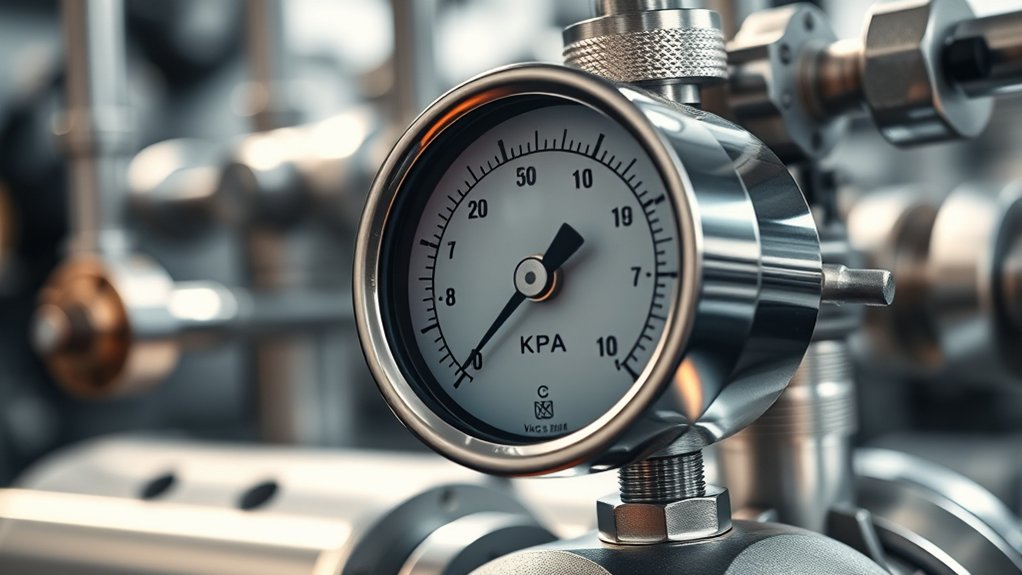
What Is a Good kPa for Vacuum Systems?
A good kPa for vacuum systems typically ranges between -70 and -95 kPa, depending on your specific application and system requirements. Maintaining the correct vacuum pressure is crucial for optimizing performance, ensuring safety, and preventing damage.
Understanding the ideal kPa range helps you achieve efficient operation and energy savings. This range strikes a balance—ensuring efficiency, safety, and best system performance without causing damage or wasting energy.
You’ll want to monitor your vacuum pressure carefully using reliable tools and adjust it to avoid leaks or wear. Understanding these ideal levels helps you keep your system running smoothly and extend its lifespan.
There’s more to explore about fine-tuning and maintenance to get the most from your vacuum setup.
Key Takeaways
- A good vacuum kPa depends on the application, typically ranging from -20 kPa (rough vacuum) to below -99.9 kPa (high vacuum).
- Food packaging requires around -80 to -90 kPa for optimal vacuum sealing and product preservation.
- Laboratory and scientific uses demand precise vacuum levels near -95 to below -99.9 kPa for accurate experimental results.
- Proper vacuum pressure improves system efficiency, product quality, and equipment lifespan while preventing leaks and damage.
- Regular monitoring with calibrated gauges and maintaining system seals ensures stable and effective vacuum kPa levels.
What Is kPa in Vacuum Systems?
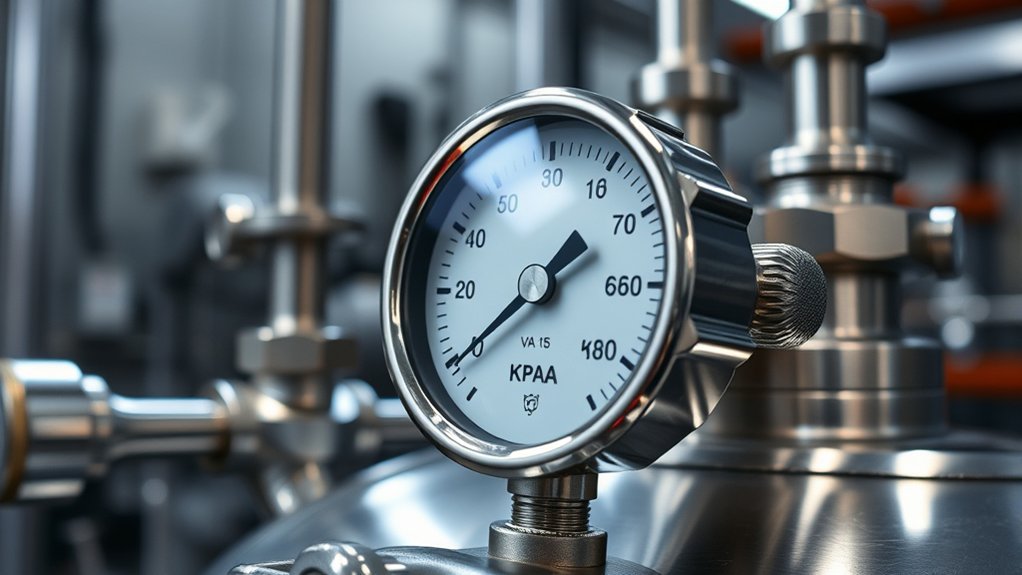
When you work with vacuum systems, understanding kPa is essential because it measures pressure in kilopascals. Kilopascal (kPa) is a unit of pressure that quantifies the force exerted per square meter. In vacuum systems, it helps you gauge how much air pressure is reduced compared to normal atmospheric pressure.
Unlike other units such as psi, kPa offers a straightforward metric that aligns well with scientific and engineering standards. You use kPa to identify how deep the vacuum is by comparing the absolute pressure inside the system to the standard atmospheric pressure outside. This understanding lets you control and optimize the vacuum process effectively, ensuring your system operates efficiently and safely without over- or under-pressurizing.
How Is Vacuum Pressure Measured in kPa?
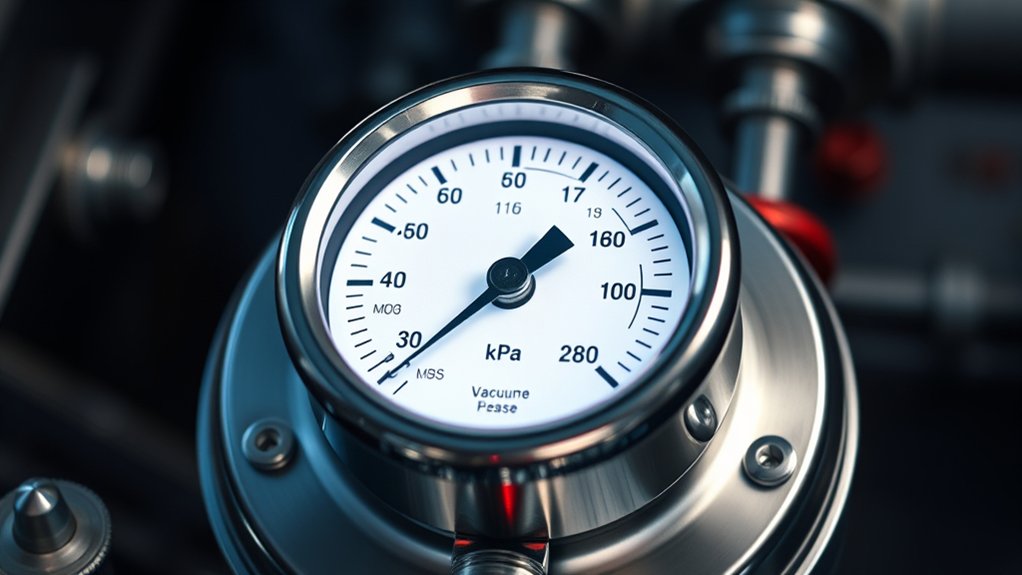
When you measure vacuum pressure in kPa, you’ll use specific units that relate to force per area. It’s important to know the difference between absolute pressure, which measures from a perfect vacuum, and gauge pressure, which measures relative to atmospheric pressure.
Understanding these distinctions helps you get accurate readings in your vacuum system.
Units of Measurement
How do you measure vacuum pressure in kilopascals (kPa)? You use pressure gauges designed to detect pressures below atmospheric levels. These devices typically show how much pressure is reduced compared to the outside air, expressed in negative kPa values or as a positive number less than atmospheric pressure.
Since 1 kPa equals 1,000 pascals, it’s a practical unit for vacuum systems, balancing precision and readability. Common instruments include digital vacuum gauges and manometers calibrated in kPa. When you read these tools, they provide a clear measurement of the vacuum level, helping you monitor system performance effectively.
Understanding these units lets you confirm your vacuum system operates within the desired range for excellent results.
Absolute vs Gauge Pressure
Although vacuum pressure is often discussed in terms of kilopascals (kPa), understanding whether measurements refer to absolute or gauge pressure is crucial for accurate interpretation.
Absolute pressure measures pressure relative to a perfect vacuum (0 kPa), while gauge pressure measures relative to atmospheric pressure (around 101.3 kPa at sea level). Since vacuum systems operate below atmospheric pressure, gauge pressure readings will be negative or zero, but absolute pressure remains positive.
Here’s a quick comparison:
| Pressure Type | Reference Point |
|---|---|
| Absolute Pressure | Vacuum (0 kPa) |
| Gauge Pressure | Atmospheric pressure |
| Typical Vacuum kPa | 0 to ~101.3 (absolute) |
Knowing which you’re dealing with helps you correctly assess vacuum levels.
Typical kPa Ranges for Different Vacuum Applications
Because vacuum systems serve a wide range of purposes, their typical pressure levels in kilopascals (kPa) can vary considerably depending on the application. For example, in food packaging, you’ll find vacuum pressures around -80 to -90 kPa, enough to remove air without damaging delicate products. In laboratory settings, you might see pressures ranging from -90 to -99 kPa, creating stronger vacuums needed for experiments.
For HVAC systems, typical vacuum levels hover near -70 to -80 kPa to guarantee efficient refrigerant recovery. Meanwhile, vacuum forming processes usually operate between -85 and -95 kPa to shape materials accurately. Understanding these ranges helps you select the right vacuum pressure for your specific task, ensuring efficiency and protecting your equipment.
Industrial Vacuum Pressure Ranges in kPa
Understanding the typical kPa ranges for various vacuum applications gives you a solid foundation to explore industrial vacuum pressure ranges more specifically. In industrial settings, vacuum pressures usually range from about -20 kPa to -95 kPa, depending on the process. For example, rough vacuum systems used in material handling or packaging often operate around -20 to -40 kPa.
Medium vacuum levels, between -40 and -70 kPa, are common in processes like drying or degassing. When you need higher vacuum, such as in coating or molding, pressures can approach -95 kPa. Knowing these ranges helps you select the right equipment and maintain efficiency.
Keep in mind, industrial vacuum systems prioritize reliability and consistent pressure for ideal performance in demanding environments.
Scientific Vacuum Pressure Ranges in kPa
When you immerse yourself in scientific applications, vacuum pressures often reach much lower levels than in industrial settings, ranging from about -95 kPa down to near absolute vacuum. In laboratories, you’ll encounter pressures measured in millipascals or even lower, essential for experiments in physics, chemistry, and materials science. These extreme vacuums minimize gas molecules, allowing precise control over reactions and particle behavior.
Scientific vacuum systems frequently operate in high (around -95 to -99.9 kPa) and ultra-high vacuum ranges (below -99.9 kPa). Achieving and maintaining such low pressures requires specialized equipment like turbomolecular pumps and ion pumps. Understanding these ranges helps you select the right vacuum system for sensitive research where even slight pressure variations can impact results profoundly.
Household Vacuum Pressure Ranges in kPa
Although household vacuum systems don’t reach the extreme pressures seen in scientific settings, they still operate within specific pressure ranges measured in kilopascals (kPa). Typical household vacuums generate a vacuum pressure between -20 kPa and -80 kPa relative to atmospheric pressure. This range is sufficient for everyday cleaning tasks, effectively removing dust and debris from floors and furniture.
Handheld or lightweight vacuums usually produce pressures around -20 to -40 kPa, while more powerful upright or canister models can reach closer to -80 kPa. Keep in mind, these pressures refer to the negative gauge pressure inside the vacuum nozzle or hose, indicating suction strength. Understanding these ranges helps you choose the right vacuum for your cleaning needs without overestimating the system’s capability or power requirements.
How Environment and Equipment Affect Vacuum kPa Levels
How do different environments and equipment types influence the vacuum pressure measured in kPa? You’ll find that temperature, humidity, and altitude all impact vacuum levels. For instance, higher altitudes reduce atmospheric pressure, which can affect how your vacuum system performs and the kPa it registers.
Equipment design also plays a vital role—sealed systems maintain consistent vacuum better than those with leaks. The type of pump you use matters, too; rotary vane pumps and diaphragm pumps create different vacuum ranges. Material wear and maintenance status influence the vacuum’s stability, so keeping your equipment in good shape guarantees accurate kPa levels.
Understanding these factors helps you manage your vacuum system more effectively and maintain the desired pressure for your specific application.
How Vacuum Pressure Impacts System Performance
Because vacuum pressure directly controls the force exerted within the system, it profoundly affects performance and efficiency. When you maintain the right kPa level, your vacuum system operates ideal, ensuring consistent suction and reliable processing. Too low, and you’ll notice slower response times, reduced throughput, and potential process failures.
Too high, and you risk damaging components or causing leaks. Precise vacuum pressure helps you balance energy consumption with operational effectiveness, preventing unnecessary wear and tear. By monitoring and adjusting vacuum pressure, you can achieve smoother system cycles, better product quality, and longer equipment lifespan.
Ultimately, understanding how vacuum pressure impacts your system empowers you to fine-tune performance for your specific application needs.
Signs Your Vacuum Pressure kPa Is Too Low or Too High
When your vacuum pressure kPa strays too far from the ideal range, you’ll quickly notice signs that something’s off. If the pressure is too low, you might see reduced suction power, slower operation, or incomplete evacuation of air or gases. This can cause your system to work harder, leading to higher energy consumption and potential overheating.
On the other hand, if the kPa is too high, you could face issues like excessive noise, increased wear on components, or even damage to sensitive parts due to over-vacuuming. You might also spot leaks or inconsistent pressure readings. Recognizing these signs early helps you avoid costly downtime and maintain efficient system performance.
Stay alert to these symptoms for smooth vacuum system operation.
How to Adjust and Maintain Correct Vacuum Pressure kPa
To keep your vacuum system running efficiently, you need to regularly check and adjust the vacuum pressure kPa to stay within the ideal range. Start by inspecting all connections and seals for leaks, as even minor leaks can cause pressure drops. Adjust the vacuum regulator or control valve to fine-tune the pressure, ensuring it aligns with your system’s specifications.
Clean or replace filters and maintain pumps to prevent blockages that affect pressure stability. Monitor the system during operation and make gradual adjustments rather than drastic changes to avoid instability. Keep a maintenance log to track pressure changes and actions taken.
Best Tools and Sensors to Monitor Vacuum Pressure kPa
Although maintaining the correct vacuum pressure kPa is essential, you need reliable tools and sensors to monitor it accurately. Choosing the right equipment guarantees your system runs efficiently and prevents costly downtime.
Here are four top tools and sensors to consider:
- Digital Vacuum Gauges – Provide precise real-time readings and often include data logging.
- Capacitance Manometers – Offer high accuracy for low-pressure ranges, ideal for sensitive applications.
- Thermocouple Vacuum Gauges – Suitable for mid-range vacuum levels and quick response times.
- Piezoelectric Sensors – Durable options that handle dynamic pressure changes well.
Common Mistakes to Avoid When Setting Vacuum Pressure kPa
When setting vacuum pressure kPa, don’t overestimate the required levels or you’ll waste energy and risk damage. Make sure you check for system leakages regularly, as ignoring them can throw off your readings.
Also, stay on top of maintenance to keep everything running smoothly and accurately.
Overestimating Required Vacuum
If you overestimate the vacuum pressure needed for your system, you risk wasting energy and causing unnecessary wear on components. Setting a vacuum level higher than necessary can lead to several issues you should avoid:
- Increased power consumption, driving up operational costs.
- Faster degradation of seals and pumps due to excessive strain.
- Potential damage to sensitive materials or products being handled.
- Reduced system reliability, leading to more frequent maintenance and downtime.
Ignoring System Leakages
Since vacuum systems rely on maintaining consistent pressure, ignoring leakages can quickly undermine your efforts to set the correct vacuum level in kPa. Even small leaks allow air to enter the system, causing pressure fluctuations that make it impossible to achieve or maintain your target vacuum.
If you don’t identify and seal these leaks, you’ll waste energy as the system works harder to compensate, raising operational costs and reducing efficiency. To avoid this, regularly inspect all joints, seals, and connections for signs of wear or damage. Use leak detection tools or soapy water to pinpoint leaks quickly.
Neglecting Regular Maintenance
Why do so many vacuum system issues stem from neglecting regular maintenance? When you skip routine care, your system’s efficiency drops, and you risk costly breakdowns. You might think your vacuum is fine, but small problems can quickly escalate.
To keep your vacuum pressure kPa stable and effective, don’t overlook these key maintenance tasks:
- Check and replace filters regularly to avoid clogs.
- Inspect seals and gaskets to prevent leaks.
- Lubricate moving parts to reduce wear and tear.
- Monitor system performance and adjust settings as needed.
Frequently Asked Questions
Can Vacuum Pressure kPa Readings Be Affected by Altitude Changes?
Yes, vacuum pressure kPa readings can be affected by altitude changes because atmospheric pressure decreases as you go higher.
You’ll need to adjust your measurements or calibrate your system to get accurate vacuum readings.
How Does Humidity Impact Vacuum System kPa Accuracy?
Humidity affects vacuum system kPa accuracy by altering air density and moisture content, which changes pressure readings. You’ll notice more variability in humid conditions, so calibrate your sensors regularly to maintain precise vacuum measurements.
Are There Safety Concerns With Operating Vacuum Systems at Extreme kPa?
Sure, if you enjoy explosions or implosions, crank up that vacuum! But seriously, operating at extreme kPa can cause equipment failure or injury.
You’d better follow safety protocols and use proper gauges to avoid disaster.
What Materials Are Best for Vacuum Seals at Different kPa Levels?
You’ll want silicone or Viton for low to medium kPa levels, while fluorocarbon or PTFE seals work best at higher kPa. Choosing depends on temperature, chemical exposure, and pressure to guarantee a tight, durable vacuum seal.
How Often Should Vacuum System kPa Calibration Be Performed?
You should calibrate your vacuum system kPa at least every six months; studies show inaccurate readings increase by 15% annually without verification.
Regular checks ensure precision, prevent costly errors, and keep your system running efficiently.
Conclusion
Understanding that typical industrial vacuum systems operate around -85 to -95 kPa can really help you set the right pressure for your needs. If your vacuum pressure falls outside this range, it might affect performance or damage equipment.
By regularly monitoring and adjusting your vacuum pressure using accurate sensors, you’ll keep your system running efficiently and avoid costly mistakes. Stay proactive, and your vacuum system will deliver ideal results every time.
Maintaining a good kPa for vacuum systems ensures optimal operation and longevity. Proper vacuum pressure management is key to reliable system performance and preventing equipment failure. Regular checks and adjustments help achieve the best vacuum system efficiency.